Another one from deep within the MHAM draft posts that never made it to air…until now.
Back in 2021…
I was thinking to myself the other day “you know what? There aren’t enough podcasts in the world. And golly, there sure as heck aren’t enough opinions being shared around. I should do something to rectify this immediately!”
Or, alternatively, I saw an advert for the free podcasting creator, Anchor, and thought I’d give it a shot.
Several coffees later and some playing about with low-budget graphics and ta-da! A podcast was born:
(Before you say anything, I really cannot stress the low budget-ness of this production. Low budget in the sense there is none.)
Who knows what will become of this, but basically it’s me talking to myself for up to half an hour and in episode one I talk about what lead me to start writing a blog. If you enjoy the concept of a one-woman natter then you’re in for a right royal treat.
I honestly could not be selling this venture harder if I tried. It’s just something I’m giving a go at for a bit of fun.
Surprise, surprise, it didn’t catch on and after forcing myself through four recordings I stopped podcasting and went back to pure writing. I think as much as anything it was the realisation that podcasting with free software is difficult (in that I found the free to use software incredibly limiting and of overall poor production value).
I’m currently in the process of getting the original recordings saved (would you believe it, the platform appears to give podcast owners no access to downloading their own work once published).
For now, enjoy the bittersweet car crash that was the MHAM podcast and who knows, maybe I’ll revive it one day on better terms.
**
Could you spare a dollar to support me? Donate here!
Headline: The essential marketing guide for anyone striving to become an earth-shaker in business
Review:
Marketing Launchpad: The Ultimate, No-Fluff Marketing Book for Women in Business (hereafter Marketing Launchpad) by Racquel Collard is billed as its title suggests, a direct and essential guide for women who want to take their marketing strategy (and thereby their business) to the next level. Split into three parts; “focus”, “clarity” and “bringing it all together”, Collard’s writing approach is to simplify the needless complexities of the business world and empower women to not only fight for their fair share of the market but also realise their full potential by removing imposter syndrome out of the equation.
The writing structure in this book is balanced and varied to optimise engagement, providing a number of hypothetical and real world examples (although the latter tends to be more focused on the well trodden, big name players such as branding heavyweight Apple). The book also includes colourful and attention-grabbing imagery, exercises and worksheets, as defined by the heading “time to take action”. These worksheets appear at the end of chapters and compliment the preceding content in a way that makes the tasks easy to complete and not cumbersome for readers.
Central to this book is what Collard refers to as “the marketing funnel”, an essential awareness behind every successful entrepreneur of the customer journey, from a potential client to a loyal and repeat customer. Later on in this book this simple model is applied to other aspects of marketing business, including types and purpose of a product and how these elements align with customer interest and sentiment.
Marketing Launchpad makes for a good read as something that would suit pretty much anyone going into business (despite its title, I would argue there is nothing contained here to particularly excludes a male readership). That said, using positive imagery to promote women is certainly no bad thing and in a market dominated by generic business guides with vague titles Collard has set herself from the pack by singling out a female market. It is a book that gives two fingers to the term imposter syndrome and for that alone it is a book to be likened.
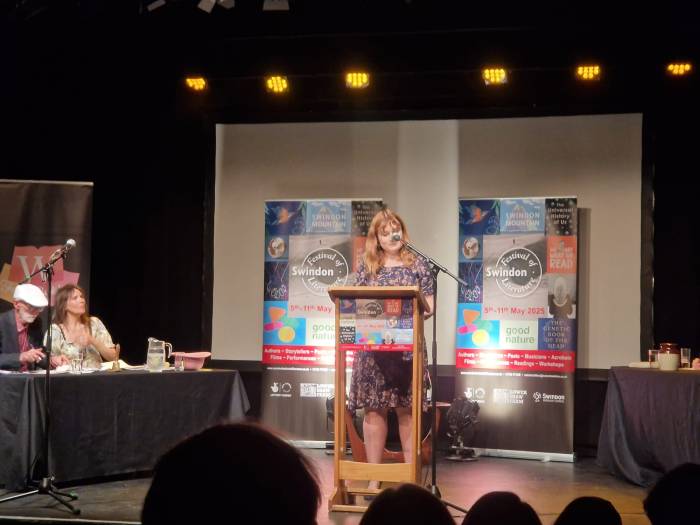
Ticking something off the Swindon bucket list, I can now say I’ve experienced the delight of reading/performing my fiction to a live audience at the Swindon Festival of Literature.
A piece of self-penned fiction, my story had the added “challenge” of needing to be performed in three minutes and in a way that kept the audience begging for more. I loved every second of it.
No performer is worth half of their talent without their trusty roadies. Ben did a brilliant job at suggesting revisions to my piece during the drafting stage, watching my performance in living room rehearsals and, most importantly, pumping me full of sugar and positivity on the night itself. (He’s also a dab hand at a camera.)
Thank you to the organisers of this event for helping to promote fresh voices and giving authors the platform to engage with new audiences.
**
Could you spare a dollar to support me? Donate here!
Headline: “This is Wisdom”: a poetry collection driven by passion but executed in a way that feels somewhat lacking
Review:
This is Wisdom: By Understanding My Poetry, is a collection of poems penned by author Ronnell Beaty.
Spanning 244 pages, the poetry collection itself covers around 200 pages. Topics of Beaty’s writing includes the spiritual and physical, as the reader transverses the inner workings of the poet’s deepest thoughts. Most of the poems in Beaty’s collection are constructed as one line stanzas, with key words or phrases formatted in a bold typeface for added emphasis. This often results in a tone of voice that is either very punchy, or symbolic of the monotony of mundane human thoughts, witnessed strongly in the poem “I Be The First To Listen – And The Last To Speak!”. In this poem, Beaty transports readers into the head space of someone stripped of their voice. The deployment of repetition in this poem strikes out acutely across the stanzas, including the lines, “I don’t, // Even speak. // I just: // Listen… // I just: // Listen…” Used in this way Beaty’s words showcase an individual reduced to boredom, or even submission itself.
While there are some respectable elements of this collection, Beaty’s overuse of the same poetic style is repetitive and dry. There is a lack of variety to demonstrate the artistic merit of the author and, by keeping the tone of voice monotonous, it does tend to inspire feelings of boredom within the readership Beaty strives to inspire.
In additional to this, and despite the book presenting itself as quick read, the number of poems in this monosyllabic style becomes hard to overlook. It is what prevents This is Wisdom from inspiring much beyond a stifled yawn. There is talent in Beaty, so potentially the collection would have benefitted from being split into two distinctive books, done so to include more variety of poetic deployments.
A poetry collection driven by passion, This Is Wisdom is executed in a way that sadly feels somewhat lacking.
Headline: This darkly beautiful memoir yanks you in by the collar and refuses to let go
Review:
‘The past is a foreign country; they do things differently there’” were the words of L.P. Hartley, a quote strikingly applicable to the Middle East experiences of Ashe Stevens during 2006, while working in the Lebanese capital city of Beirut.
Jointly written with Magdalena, Ashe Stevens’ memoir Lost in Beirut starts as two business partners trying to orchestrate a concert for the rapper 50 Cent. A first time traveller to the region, Ashe is thrown headfirst into a strikingly different culture to his American roots. A place where economies halt five times a day for prayers and family reputation is everything. Ashe quickly discovers the latter for himself when he starts dating Aleyna, a woman who hails from a high-profile family in the Hezbollah district of Beirut.
Unknown to the city’s bustling residents, while the stage is being prepared for a career-defining concert, a bigger threat is brewing across the boarder in nearby Israel. In the days that follow, society is flipped from prosperity and glamour into a landscape where money means nothing and an American accent is enough to have you killed on sight. With the airport bombed and all roads out the country destroyed, Ashe must fight a new battle of his own and find an escape from within the rubble of Beirut.
Lost in Beirut is a highly likeable book, packed with beautiful imagery of a thriving city both before and after the months of bombing attacks. Written in first person present, it does take a few chapters to adapt to the tone of voice and tense (memoirs generally being written in past tense which makes for a more reflective style, whereas this feels more reactive). Once you get past this though the story yanks you in by the collar and refuses to let go, really coming into its own in the final third of the book where you get a sense of society falling apart. The world-building is more apocalyptic in this section, you can feel the raw panic of the mega rich on discovering their money is worthless, their expansive villas levelled flat in minutes. You would believe it to be a work of pure fiction, if it were not for the sadness that these events are true and actually happened. People died in this conflict.
A touching and, at points, quite graphic memoir, I come back to Hartley’s quote. With well over a decade having transpired between the 2006 Lebanese war and now, can we still claim the past to be a wholly foreign country? Or maybe we have to move on, embracing acceptance with the scars that are left.
Last week I was incredibly fortunate to spend a day volunteering in a local secondary (high) school, helping to deliver one of Young Enterprise’s educational programmes, “Learn to Earn”.
The programme involves helping younger students (aged 12-13) get to grips with the basics of goal-setting and budgeting (e.g. establish the difference between “needs” and “wants”). During the day I was also able to present to the full year group of 180 students, sharing my career journey from History degree, to delivering a spectrum of digital change at my current employer. I also got to meet other professionals from outside my employment sector, which was a fun and fascinating networking experience by itself!
Overall, it was a great day and I’m very thankful to The Dorcan Academy and Young Enterprise for giving me the opportunity to be involved.
To find out more about Young Enterprise and volunteering opportunities in your area, click here.
**

Could you spare a dollar to support me? Donate here!
Headline: When it comes to navigating the world of maternity leave, this book does it all
Review:
As authors of self help guides go, Emily Malloy has pretty much everything you need to make a good book, great. A Canadian advertising professional with fifteen years of experience, bachelor in economics under her belt and a mother of two. Malloy uses her experience in the latter category to pen her recent publication, Matleisure: Maternity Leave Survival Guide & The Art of Enjoying It (hereafter Matleisure).
Matleisure covers a wide range of topics for expectant mothers, from monetary finances to the importance of building a community and nutrition nourishment. The book’s tone of voice is informal in approach yet informative, with Malloy providing plenty of hints and tips throughout from her own personal experiences of going through maternity leave. There are even some handy recommendations in a bonus section at the end, including several recipes that are both healthy and easy to make (recipes you do not need to be pregnant to enjoy!) The formatting of the book is also complimentary, with chapters kept to a reasonable length and the font adjusted to an appropriate size for easy reading.
Even if the arrival of a child is the bringer of ultimate highs and bottomless lows, Malloy’s guidance helps steer parents through the fog and out the other side. Matleisure demystifies many of the false expectations and ideals of parental life, encouraging parents to embrace and enjoy this time in their lives. For some topics where an intermediary may be required, Malloy helpfully provides contact information of third party charities and services (some of these are tailored toward American and Canadian audiences, however for the most part Matleisure has universal appeal).
Matleisure is a very easy-going read and one that is highly commendable. When it comes to navigating the world of maternity leave, this book does it all.
Work blessed upon me the opportunity to take off a few days (otherwise know as “use it or lose it”). While boyfriend Ben toiled away with delights of his own, I used the opportunity to spend four (and a bit) days in and around Chichester in South England.
Day 1 – Winchester
On my drive down to Chichester I stopped off at Winchester for half a day.
Top tip: expect to be persistent with parking. I drove around the two “park and walk” car parks on Worthy Lane for thirty minutes before striking up a conversation with a pedestrian and taking his space when he left. Park and walk car parks are limited to four hours maximum stay.
It had been years since I’d visited Winchester, when the city was a source of escapism from my studies at Southampton University. Strolling around some of the quieter streets I found a building that included a brick laid by one of Swindon’s historic mayors, a claim to fame worthy of a photo.
Winchester Cathedral is where I spent the bulk of my time. First at the cathedral’s café, tucked away behind a high wall at the front of the cathedral, and then in the cathedral itself. The last (and coincidentally first) time I visited was in 2011, which ultimately swayed me into the decision to pay £13.50 for entry (valid for a year).
As well as hosting many examples of beautiful architecture, the cathedral also contains a memorial stone to Jane Austen and a permanent exhibit, “Kings & Scribes”. The three levels of the exbibit include the cathedral’s history, original biblical scripts and a King James I bible. A personal highlight was the the Bishop Morely library, full of old dusty books on pretty much every topic known to medieval man. Friendly volunteers were on hand throughout to answer questions.
Jane Austen memorial stone
Inside Winchester Cathedral
Filled with a hefty dose of history and teacake, I headed back to my car and drove onto Chichester and the little cottage I’d booked. I spent the evening with a ready meal and got an early night, ready for the day ahead.
Day 2 – Chichester
On my first full day I made the most of everything outdoorsy the city had to offer. This started with coffee and homemade cake at the Canal Café, a volunteer-led operation at the Chichester Ship Canal Trust. A lovely way to spend an hour people watching.
On the balcony of the Canal Café, Chichester
In what was meant to be “ten minutes one way, ten minutes back”, I ended up taking a leisurely stroll along the length of the Chichester Ship Canal.
The canal itself is a pleasant walk, flat terrain with information boards dotted along the full course. This stretch is also believed to contain the view that inspired the famous “Chichester Canal” painting by artist J.M.W. Turner.
The view that inspired Turner: Chichester canal, with the spire of the cathedral visible in the distance
I caught one of the frequent buses at Chichester marina to get back into the city centre (the circular route involves walking along a stretch of very busy road with limited footpaths).
In the afternoon there was time to visit The Novium Museum, a free to enter museum which features sizable remains of a Roman bath house, alongside permanent and rotational exhibitions on the history and culture of Chichester. It’s also the home of the city’s tourist information point.
In the evening I dined at Franco Manca, Chichester. They put me in the window, providing a lovely view of the Cathedral at night. Sadly, service was pretty poor, I felt like I’d been completely forgotten about.
Day 3 – Arundel/ Chichester
Waking up slightly later than planned, I made the fifteen minute drive to the town of Arundel to be greeted with ample parking in one of the main car parks.
Top tip: Stays of over four hours = a sharp increase in parking charges, so consider taking the train if you plan on visiting for the full day. Trains run frequently from Chichester to Arundel station, which is about 15/20 minute walk from the town itself.
Arundel Castle was sadly closed at the time of visiting, but that didn’t take away the enjoyment in having a leisurely stroll around the small streets and independent shops that call Arundel their home.
A visit to Arundel Cathedral is a must for those who can squeeze it into their itinerary. As well as being free to enter, this cathedral is a central feature point on the Arundel skyline and one of the few Roman Catholic cathedrals in England (blame Henry VIII).
Inside Arundel Cathedral
As a side note, I was disappointed to have missed out on Arundel Castle due to its seasonal openings. Given the number of people milling around Arundel, I think the owners may have missed a trick. Another attraction for another time, maybe!
After driving back to Chichester in the mid afternoon, I visited another cathedral (my third in as many days). Chichester Cathedral is free to enter.
Chichester Cathedral
At the time of visiting, the cathedral had an exhibition to celebrate its 950th anniversary. For a free-to-enter site, the standard of this exhibition was high, with colourful and engaging boards, and cabinets filled with carefully selected artefacts from the cathedral’s collection.
Inside Chichester Cathedral
In the evening I ate at the Italian restaurant Piccolino, Chichester. It was very busy, and the prices a little bit on the steep side. They seated me in the front window, which doesn’t usually happen as a solo diner! Owing to the price, I went for a simple pasta dish.
Day 4 – Chichester
I spent my fourth day in numerous coffee shops in Chichester. Reading and writing to my heart’s content, it was wonderful.
Morning coffee and words at The Dolphin & Anchor (a Wetherspoons with great views of the cathedral)
In the evening I ate at Bill’s Chichester. Staff were very friendly (especially given it was a Friday and the place was packed). Bill’s is a popular chain, you kinda know what you’re going to get. Good food, at a reasonable price.
Day 5 – Chawton, near Alton
Driving back home, I stopped part-way into my journey to visit Chawton, near Alton. This little village is quaint in its own merit, but what sets it apart from other Hampshire villages is its connection to literary royalty. 2025 marks Austen’s 250th birthday and by the time I’d booked my entry ticket to Jane Austen’s House I was practically whipped up into a new wave of Austen mania.
Top tip: book in advance, as numbers entering Jane Austen’s House are strictly limited. Once you’re inside you can stay as long as you like, and the small surrounding garden has no time restrictions. Dogs are not allowed inside the house.
Jane Austen’s House, Chawton. It is in this house that Austen worked on and published Sense and Sensibility, Pride and Prejudice, Mansfield Park, Emma, Northanger Abbey and Persuasion.
The house is part staged reconstruction (downstairs), part exhibit (upstairs). Seeing Jane’s writing table and her surviving hand written manuscript drafts on tiny sheets of folded paper, shows that in the literary world size doesn’t always matter.
Jane Austen’s writing table.
After the house, I sat in the garden and read my book, before making my peace and exiting through the gift shop, avoiding all eye contact with the highly tempting merchandise on sale.
The garden at Jane Austen’s House is the perfect spot for a moment of tranquillity.
After Austen’s house it felt only right to pay my respects at the gravesite memorials of Cassandra Austen and Cassandra Leigh, Jane’s sister and mother who are buried at St Nicholas Churchat the other end of the village, next to Chawton House (former home of one of Jane’s brothers, Henry). The interior of the church is pleasant enough, however is a little overshadowed by the long line of people marching past the front door to get sight of the Austen graves tucked around the back.
From Chawton I drove back home, returning by the late afternoon and ready for a cup of tea and a full debrief with Boyfriend Ben. A chilled Sunday followed, before returning to work on the Monday, refreshed and ready to take on the 1000+ emails and twice as many Teams messages and missed Zoom calls.
A wonderful few days with the glorious weather to match. Who says you can’t get sunburn while holidaying in Britain?
AEB
NB: All prices, information and external links correct at time of writing, April 2025
**
Could you spare a dollar to support me? Donate here!
Headline: Aazmao Arn’s poetry style of four-line rhyming stanzas is homely but just a little bit repetitive
Review:
Aazmao Arn’s poetry release, Let’s meet through the four rhyming lines, speaks to some of the core elements of what it means to be human. Born and raised in the Middle Eastern country of Qatar, Arn’s collection of poems and personal reflections were inspired by her personal drive to give readers a deeper meaning to their feelings and thoughts. Within this humble collection of thirteen poems there is a range of events and worldly interactions, from those that dive down a microscopic lens, considering the ripple effect of perception and appearance, to poems that draw inspiration from nature and how it interacts with humanity. Preceding each poem is a motivational or thought-provoking statement (for example, “Patience”, which reads, “Once you conquer patience, life can get easier.”)
There are some likeable aspects of this collection. By being written consistently in a four line stanza format with rhyming couplets, there comes a methodical and reassuring beat to each page while reading through this short book. It makes for a somewhat comforting and homely style that perfectly matches the book’s title. By constructing her poetry in this manner, Arn’s has made her poetry anything but a drag.
That said, writing in this manner does result in the poetry feeling somewhat repetitive and lacking in imagination. There are occasions where the rhymes feel a bit forced and the stanzas drawn out or abruptly cut off to make them fit into the same cookie-cutter format as all the poems that come before and after. The one sentence statements that fill every other page is also something that, personally, I feel adds little and probably would have been better used to showcase more of Arn’s poetry.
What I would love to see more of in Arn’s creative talents is a broadened use of different poetic styles and types; more variation on the poetic structure and maybe some experimentation beyond the traditional confines of a four line stanza.