And if not for the video than the comments on the video itself, including:
Now, isn’t your life so much better for watching that video? (Also, don’t answer that question.)
And no, I won’t tell you how I came about this video. And for those of you expecting this to be a video of my sister and/or my giant thumb (based off this post’s feature image…)
Headline: Childhood imaginations run wild in this fun picture book of bath time pirates
Review:
Thar She Blows! by Klam Burley (illustrated by Francesca Da Sacco) is a children’s picture book which tells the story of Bobby, a young pirate with a rascally parrot companion and a fearsome sea monster to battle. But is Bobby’s dangerous encounter all as it seems?
There is much to commend this book, including the humorous plot twist halfway through which changed the story’s direction to draw children back to a relatable environment. Children are well-known for having broad, colourful imaginations, although I would probably not have been as understanding as Bobby’s mother if I walked into a flooded bathroom!
The illustrations are nicely done, the bird’s eye perspective of the mythical sea monster flavours on the mildly surreal (think Studio Ghibli) and the slightly cartoonish depiction of Bobby maintains a sweet sense of innocence. The two forms balance each other well. The addition of hidden rubber ducks on each page adds an additional layer of engagement for parents and children; having these peppered throughout hints toward the plot twist to come.
The copy in this book could, however, be tightened. I know a good deal of adults who do not know what a semicolon is, let alone small children. In my opinion the use of this punctuation mark should not exist in a book aimed at this age demographic. The sentences are also long and clunky in places, for me the poetry did not flow naturally and I ended up having to reread pages to marry-up what sometimes could be better described as half-rhymes. Personally I think the writing would have been better as prose.
Thar She Blows! comes from a solid place. It is well illustrated and is full of the heart and charm needed for a picture book of its type. If elements of the copy were addressed Burley could find herself onto a real winner.
Few things have shaped me more than a mechanic exhibition housed in the visitor centre of Cornwall’s world famous Eden Project. Shaped me, in a negative way.
Back in 2000, when the biomes for The Eden Project were still under construction, the visitor centre was opened up to the public. I was eight years old. “This will be educational,” my parents thought, “Alice will get to see this amazing thing being built and learn a bit about the nice plants in the visitor centre.”
Plant Takeaway, an exhibition also referred to as “The Dead Cat” (which personally I think says it all) is, according to the attraction’s website, “[an] automated puppet show that explores our total dependence on plants. Visitors watch as absolutely everything made of plants in Alan and Enid’s kitchen is taken away.”
It sounds all harmless enough, sure, but let me put to you this; Plant Takeaway features scary mannequins (and you know how I feel about those), nudity and what I have always assumed to be a “Peeping Tom”. It is a reminder of the importance of plants (big tick) and how their removal will result in the painfully slow erosion of everything you hold dear (uh-oh) until ultimately you die from starvation or a lack of oxygen, which ever comes first.
“…Daddy, am I going to die?”
I can see Mumma B rolling her eyes at me now, “she’s 30 and still going on about that silly mechanical exhibit at The Eden Project” but you know what, Mum, yes, I am still going to harp on about it. There was an eight year old me, eyeball to eyeball with a naked collapsed man. To top it all off the cat dies. That’s it, THE END.
I spent the rest of the day crying. When we got back to the holiday cottage we were staying at I was in a state best comparable to that time Hermione got herself petrified in Chamber of Secrets. I remember these things because I was haunted.
I think I had a mild form of PTSD, Plant Traumatic Stress Disorder.
Years later we returned to The Eden Project, where as a teenager I was quickly rushed through the visitor centre. We’d all hoped Plant Takeaway would have been retired and thrown into a skip somewhere but nope, still there.
I was going for third time lucky when I visited last year. On seeing its ugly, clunky presence I decided to face my fears and watch it through to the bitter end.
I gave up halfway through.
In my defence I really did try, and in my equal defence this exhibition is a pile of trauma. Other people have recorded and uploaded the whole thing onto YouTube…or at least I assume so (I’m not going to check; go look yourself and on your own mental health be it).
The other 98% of The Eden Project is absolutely lovely and well worth a visit, but this? Nah. I have two questions to put to the management of this attraction 1) who in their right mind signed off the development of the Plant Takeaway exhibition and 2) who is continuing to let it stay?!
Uh-oh, I think I might have triggered myself again (passive-association from the memories). I’m off to get some ice cream.
**
Could you spare a dollar to support me? Donate here!
Headline: If you enjoy Christmas movies as much as candy canes and baked cookies, you’ll love this
Review:
I love television Christmas movies, cheery 90-minute productions where cookies are always in the oven, mugs of hot chocolate plentiful on the counter, small town celebrations every other day. More festive than tinsel itself, I cannot get enough of them. When Fred Olen Ray’s book, Writing the Perfect Christmas Movie, appeared in my inbox I could not resist, jumped at the first chance I got.
Ray is no stranger to the industry of televising Christmas charm, in the space of ten years he has written fifteen Christmas films for television and directed several more. Having spent time with aspirational hopefuls wishing to break into the industry, Ray’s guide pitches itself as a one-stop shop for any budding scriptwriters of the genre with chapters that are intended to be all inclusive of the various considerations that need to be made when putting pen to paper. From story and act structure to considerations around budgets and casting and, the all important question, how Christmassy is too Christmassy? (In the world of festive films? It transpires there is no such thing.) In a short space of time Ray does an excellent job and condensing a genre and getting the main points across professionally and informally. You get a real sense of this being an author who genuinely wants to help others break into the industry.
Ray’s approach to producing this guide is consistent with an experienced professional; recounting past projects and how to avoid potential pitfalls with each approach. It is almost semi-autobiographic, from a place of passing on experience as opposed to providing a line-by-line tutorial of scriptwriting. There is a general expectation here that you can already write screenplays. To this end, Writing the Perfect Christmas Movie could be more likened to the Masterclass brand of video tutorials and may therefore cause disappointment to those hoping to see annotated case studies of previous scripts.
A choice purchase for those who are actively trying to pursue a career in scriptwriting whilst also sitting comfortably as my recommendation to any festive film-fans, Writing the Perfect Christmas Movie offers a rare peak under the covers of what makes the seasonal film genre tick.
Headline: Three simple mantras to change mindset and create lifelong opportunities? Sign me up!
Review:
Think in Color by Sophia Santiago is a self-betterment guide which puts forth a proposition for a new way of thinking, branded “ColorThinking”.
This approach is broken down into three mantras, also referred to as mental cones:
Think “and” before “or”
Think “how” before “no”
Think “can be” before “is”
In all three scenarios theory and approach is backed-up by some interesting real-life and fictious scenarios, coupled with a step-by-step walkthrough of how things could have been better handled. A fourth section focuses on how to break away from external negative influences which may be impacting on your ability to implement a new way of thinking, and finally there is an advisory on the dangers of overuse; applying ColorThink to every scenario.
Santiago’s style of writing may not suit every reader, author jovialness bubbles to the service with the use of phrases including “just kidding!” and “a nice twist, ha?” In a self-help guide I prefer the tone of author voice to be informed and neutral; in places the over-informality of the writing distracts from the otherwise invaluable information and action items which the book is trying to impart.
As someone who works in Project Management, I really like what Think in Color is trying to do. Whether Santiago was aware when devising the concept of ColorThinking or not, the three mental cones have striking resemblance to Agile methodology, with its four simplistic principles for transforming and embedding efficient delivery. While the subject matter differs, the theory of ColorThink is similar in that respect and, at just over eighty pages in length, it is as equally digestible as another ground-breaking manifesto adopted by millions worldwide.
Think in Color convinces readers to reconsider the traditional black and white principles of thinking, offering a fresh perspective in a way that does not seem that different at all. I like it.
Headline: Questionable facts, confusing anecdotes that lead nowhere and uncomfortable levels of over familiarity. Diagnosis? Checkout
Review:
Burnout is, to pardon the pun, a hot topic at the moment. I only need to pop down to my local community centre, shop or healthcare provider and within seconds there will be someone venting about their personal frustrations of working in an increasingly pressurised environment. From this inevitably comes the term ‘burnout’, a mental health condition that can be triggered by chronic workplace stress.
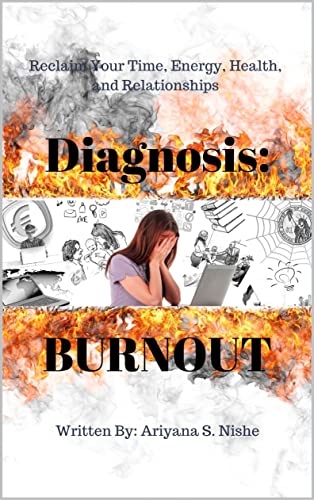
From this the writer Ariyana S. Nishe has decided to invest her passions into producing a 45-page self-help guide, Diagnosis BURNOUT.
With the subline, “Reclaim your time, health, energy and relationships” I was expecting something that could provide clear and concise guidance for those on the brink (or wanting to take proactive steps to avoid) a mental health crises. However the cover imagery is very divisive and features an eclectic mix of imagery that is distracting.
Nishe states in her introduction that burnout has been added to the list of medical diagnoses by the World Health Organisation (WHO), yet when visited the WHO website the only definition of burnout I could find was that the condition is “an occupational phenomenon. It is not classified as a medical condition.”
My confusion over the author’s interpretation of burnout left me doubting many other elements of this book. I’m not an expert on mental health conditions, let alone burnout syndrome; that is why I turn to publications like these. Yet suddenly my eye is drawn to other elements; the formatting could be tightened, use of imagery could have been reduced and improved and the tone of voice would have significantly benefitted from editorial input.
It’s clear that the author is passionate about this field of study, and I appreciate her detailed reference section to acknowledge her source materials, but it’s not enough to pull at quotes from obscure places, couple them with images pasted from search engines and label it as self-help. This is a publication that is both confused and lacking direction.
While Nishe’s attempts are valiant, sadly they don’t hold enough water to make Diagnosis: BURNOUT marketable to the audience it’s intended for. This should be seen as a product of the author’s aspiration to be published, not something for mass-market consumption. Less book material, more blog.
Find out more about the other painted doors which feature in the city of Funchal’s ‘Old Town’ district (Rue de Santa Maria). Click this link or enter “Painted doors Madeira” into your trusty search engine. There are some absolute beauties to be found.
Headline: For those who want to stay ahead of the increasingly steep and bloody curve of customer satisfaction, this book is a must
Review:
Once upon a time, loyalty was decided by large armies and costly landgrabs. A knight (or similar) would swear their loyalty and in turn all the sprawling hordes of peasants (or similar) underneath would also find themselves also pledged to that cause. But we are no longer in that period. In Westernised countries, gone are the knights, swept away the uneducated masses and in its place born is the freely accessible internet.
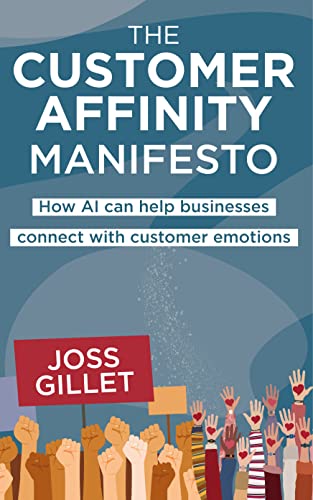
Joss Gillet’s guide to business, The Customer Affinity Manifesto: How AI can Help Businesses Connect with Customer Emotions, brings into conversation the need to incorporate artificial intelligence (AI) into brand building. Before all else, Gillet details two home truths, 1) AI is not going anywhere and 2) your business is not going anywhere without it. (The phrase “suck it up and move on” springs to mind.)
That said, Gillet is equally keen to not let AI become seen as a digital enemy, if anything in many cases throughout recent history he cites many examples of where AI systems have benefited improvements in marketing and how, before then, psychology experimentation was mimicking a lot of what we see today, be it on a much more labour-intensive scale. From telephone response times to the words and colours on a digital app, a better understanding of customer frustrations can lead to better targeted improvements. Happy customers equals happy economic growth.
Using his previous experience in the Telecommuncations sector to build a case study, Gillet identifies sixteen specific pain points (or ‘topics’) where customers feel particular disillusionment with their provider’s service. Gillet then presents the case that anyone can use deep learning to build a simple AI model to utilise freely accessible data on social media platforms, such as Twitter, to produce highly effective data charts and sentiment scores. Later on, there contains more detail about how business can implement effective AI, without needing to rely on the brand popularity of 10,000+ Tweet mentions a day.
Gillet’s book is well researched, well put together and visually is very engaging (the use of clearly explained graphs being welcomed sight). Granted, this would perhaps not be the best birthday present for someone selling the occasional bead necklace on Etsy, but for the truly aspirational, those who want to grow their business and stay ahead of the increasingly steep and bloody curve of customer satisfaction, this book is a must.
Someone abandoned their catering van on my housing estate. And I was not happy.
Look at it! It’s massive!
Naturally, I applied a very level-headed attitude to this. That’s right, I sent a ranty email to estate management. It went something like this:
WHY IS THERE A MASSIVE CATERING VAN PARKED IN A VISITOR SPACE? I’VE CHECKED THE REGISTRATION PLATE (“XXX XXX” for your reference) AND IT’S NOT TAXED OR INSURED. IT’S UGLY AND CLEARLY BEEN ABANDONNED. I PAY MY MANAGEMENT FEES, SORT IT OUT!
(The caps are a reflection of the shouty voice in my head…I may have also left the last bit out.)
Estate management responded, saying thay they’d located the vehicle’s owner and told them to move it within the next 48 hours.
48 hours came and went, the van unmoved.
I wish I could say I became tolerant of the pudding van’s presence, but when you’re facing onto something like that every time you go to make a cup of tea, it’s very hard to let go. (Plus, you know, me.)
Whilst waiting for the owners to be chased up again, I did a little investigation of myself. By in investigation, I meant be super nosey.
There weren’t any company details on the van and the only online presence seemed to take me back to a deactivated Facebook page, from when it operated out of Pershore some 56 miles away.
Instead of hard, concrete information, I had to deal with statements like this:
It reads: “Feeling stressed? Stressed backwards is desserts”
I don’t know what bothered me most; the font, the words or the fact that it’s annoyingly true. Everything about it grated on me more than the sugary sweetness of the food it claimed to provide.
**
Update: I drafted this post in September 2021, however in June 2022 the van disappeared altogether. I assumed it was at local festival but it never came back and I haven’t seen the van since. No idea what has happened but the problem of the Pudding Van seems to have sorted itself!
I’m totally putting it down to my ability to moan, that or my top-notch judgemental stares out the window.
(And as for why I’m not posting this until now…well, I forgot I’d written it.)





















 My Housemate's a Mermaid