My recent review on a local Tandoori restaurant gave burns hotter than their curries.
http://www.theswindonian.co.uk/24429/271585/a/girl-about-town-biplob-tandoori-old-town

My recent review on a local Tandoori restaurant gave burns hotter than their curries.
http://www.theswindonian.co.uk/24429/271585/a/girl-about-town-biplob-tandoori-old-town
One classic novel, five modern minutes to write up its review…
Far From the Madding Crowd by Thomas Hardy is a novel which depicts the relaxed pace of life in the countryside of 19th century England. It essentially tells the tale of three men from different backgrounds fighting for the love of one woman. You come to dislike them all to more or lesser degrees. Bathsheba (yes, that is her name) is a character with little warmth to her personality and, like all urban dwellers of the period, treats her rural tenants like dirt on her shoe. There’s Gabriel Oak, a hapless shepherd which following disaster finds himself working for the rich and snobbish Bathsheba. To say Oak is obsessed with Bathsheba would be a vast understatement. It’s no plot spoiler to say he proposes to Bathsheba and gets turned down within the first couple of chapters (keen much?). Then you’ve got the more maturely aged farmer Boldwood who, after receiving a wicked joke Valentine’s card, becomes infatuated with our female lead. Finally there’s Sergeant Troy, a passing army figure and notorious womaniser. Guess which one Bathsheba takes a shine to?
People often get doe eyed with the English rural landscapes depicted in this novel, but I don’t see it. To me this novel depicted country folk as a backwards breed who spend all their time rambling on and on about nothing at all. One of the few times I felt sympathy for Oak was when he was trying to get urgent help but had to contend with a bunch of idiotic drunkards in a pub. Who is going to give you money for booze if your mistress is dead Mr. Poorgrass, WHO?
Like a lot of literature from this period of writing, footnotes take dominance across most pages and the copy had religious and general ‘thing’ references which I imagine very few people would be able to understand two centuries later. I started off trying to read all the footnotes but quickly gave up when I found I was spending more time reading footnotes than I was when I was at university. Unfortunately it meant that supposedly hilarious jokes and witty comments made absolutely no sense.
If you’re a fan of Austen you’ll like this but Stephen King obsessives keep well away.
This evening I was reintroduced to a world of vice and nutritional sin. My old foe reared its ugly, cream filled, head and called to me from across the supermarket floor. Standing at the reduced bread stand I heard it whispering to me and made the fatal mistake of making eye contact. It was at that point my destiny for the evening was sealed. My poor body never stood a chance. The name of this dastardly snack? Custard creams.
A whole pack of custard creams now lay decimated on my bedroom floor, the empty wrapper and a string of pale crumbs serving as the only reminder that here once stood a tall stack of heavenly sin. The scrunched up wrapper of a product once fulfilled and bulging, now hollow and useless.
I dare not study the custard cream wrapper at length, the nutritional values which once seemed hidden from view now laugh at me in mockery, inspiring those inner feelings of guilt and shame. “You’ll remember this one moment of weakness for years to come!” it cackles. In frustration I reach out and grab the snack wrapper with such aggression that the orange skin lets out a rustling squeak. I thrust my hand into the bin and release my prisoner there to join the rotting carrot and greasy pizza boxes, before walking out of the room and switching off the light.
Wrapper dealt with I thought the guilt and ill feeling of consuming 50,00,000 calories in one sitting was removed from my life. I pick up a book and start reading in a bid to distract my mind. A little voice pipes up from deep inside me, it is coming from my stomach. It says “you thought you could dispel me so easily? You fool!” And the self loathing begins again.
The devil lives inside me and he is not red, nor is he a horned beast. He is a custard cream.
Alongside news outlet The Swindonian, I’ve started doing freelance work for the ‘what’s on’ website Total Swindon too. Check out my recent review on Swindon based restaurant, 20 at The Kings, here:
Standing in the terminal of Oxford railway station I’m familiarised by a classic mix of passenger. The cyclist awkwardly pushing her bike through the ticket barriers, a toddler being led by the impatient mother, the Asian tourist with overflowing bags in hand. Watching the tides of people pour in and out of the confined space it reminds me that at any given moment the order of society, including this station, sits on the brink of collapse and chaos. All it takes is one broken signal and everything will grind to a halt.
If you thought the term ‘diversity’ could only be applied to whole streets and towns then you may need to think again. For contained in these four walls of peeling white paint, tapped across the utilitarian stained floors there speaks a more fascinating image of a fast-paced melting pot. An environment where, for the most fleeting of seconds, East bumps into West, North connects with South, rich mingles with poor. At this train station everyone is unified in the same gripes and grumbles. A delayed train, an out of order toilet, another drunk passenger, they are all received with the same unimpressed reaction.
Waiting for an old friend to arrive from London I am left to wandering thoughts which flow as seamlessly as the passengers coming in and out of the terminal. In this sea of faces and voices which type of passenger am I? Someone awkwardly shuffles behind me to get to the ticket booth I inadvertently block. Does my insistence at lingering beyond my welcome make me the tourist? Men in suits glance my way for a short period before I realise they are staring at the LED light boards above my head. If they are London bound they will need to go to platform one. Does my in-depth knowledge of platform order make me more a commuter? Next to the screaming child and passive aggressive guards it’s hard to think much beyond the bigger question “why am I here still?” It is just at this very point that my friend greets me with a cheery welcome, snapping me out of trance.
Leaving behind the dim and crowded terminal and entering the light exterior my friend’s first thoughts mark a very different take on modern life. “What an awful building!” he says, gesturing to the bricks behind. All thoughts of passengers and trains disappear as I’m faced with a more pressing question from my companion, “now, where on Earth are we headed to Miss Bennett?”
If only life and cityscapes were as easy to interpret as the passengers at train terminals.
Ergh, do I have to spend five minutes on this? Ok, fine.
The Food of Love by Anthony Capella is a rom-com novel, based in and around the streets of Rome, Italy. The plot follows the story of two Italian men who work in the restaurant industry, as they fight for the love of one woman (what’s new there?) The more attractive of the two, self-styled player Tommaso, woos the fair American student, Laura, first by convincing her of his extraordinary culinary skills. The catch? He cannot cook to save his life. However his roommate, the less attractive and uncharismatic chef Bruno, can. Secondary catch, he too is in love with Laura (dun, dun, duuun). So instead of confessing his love what does he do? He helps his player friend by teaching him culinary skills to charm the fair lady, thus becoming the ultimate wing man/gooseberry. Unsurprisingly as the lie gets bigger so too does the (supposedly) hilarious consequences.
As my sister noted when I told her the synopsis, The Food of Love story is basically an Italian version of the Disney film Ratatouille. If you liked that story, but wanted something with more sex, swearing and over sexualisation of mushrooms then you’ll probably enjoy this. *
I should have known that this book would not be an Austen or Orwell when I picked it up in a charity shop for 50p (on sale). At the time I needed a light read as a rest bite from more serious subject matter. No guesses for where my copy will be swiftly going back to in the next week.
*FYI rats and bestiality do not feature in this novel, at least the author didn’t stoop to that level.
Ok, so let me get straight to it, yesterday was my first Valentine’s Day with a another human being* (*not to say it’s the first Valentine’s spent with company, I have enjoyed many a V Day with cats, TV, wine, chocolate…). However I just can’t seem to get my head around making a song and dance out of chocolate and roses. I thought it would make complete sense when you have someone to buy stuff for but instead it’s actually worse. Its like Inception, the deeper and more involved you get the less and less it makes any shred of sense.
For me, the pinnacle of the V Day confusion and inner turmoil was the important part of selecting a low to medium value cruddy piece of tree we call ‘gift cards’ (you can probably see where this post is going already). The difficulty selecting a suitable Valentine’s Day card embodied completely the inner awkward-come-British-come-Alice reaction to the whole Western festival.
Now most people (including the tall bearded one) just write in their cards, “To X…Love Y” No one gave me this memo. As a result, instead of getting a cutesy, charming note, my Valentine essentially got a passive-aggressive message reflecting the inner frustrations of his other half’s quest to find (and buy) said card.
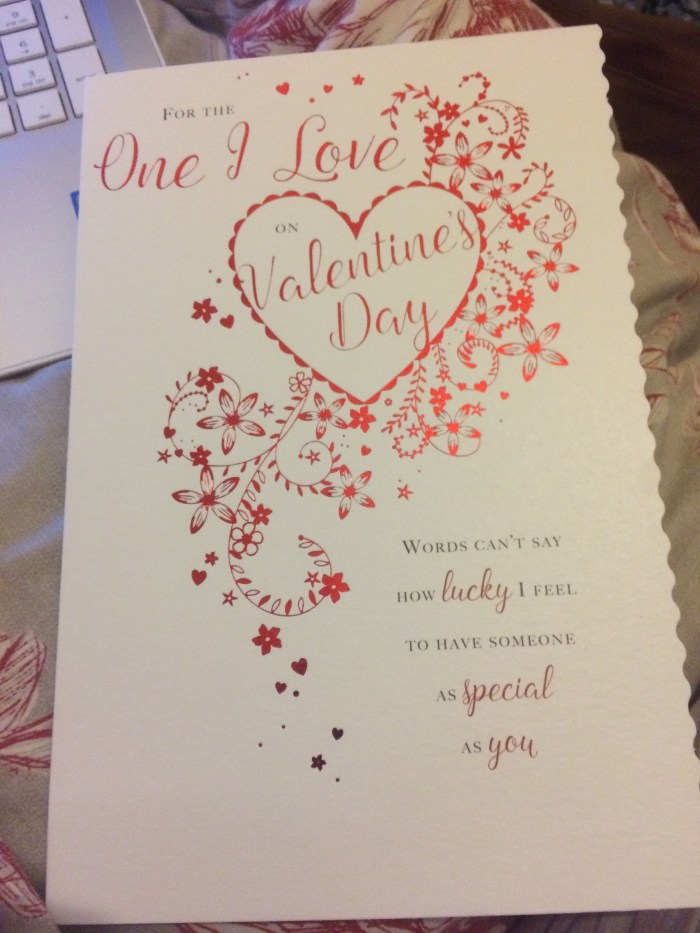

Message reads as follows:
To Stewart,
My God, if you knew how much middle class, British, stress I went through just to find this ruddy card. Like seriously why do all Valentines cards have to be either so ridiculously over the top (since when are men turned on by fluffy bears?!) or look like they belong at a funeral? Christ, where is the middle ground? It’s like buying low fat hummus when there’s a shortage – it shouldn’t be that big a deal but it damn well is!
Anyway, happy Valentine’s day. Your face and personality are kinda awesome (unlike my lovey dovey card writing abilities). I bought you man stuff (vodka + energy drink) because they contain red. Boom – should plan weddings.
Christ, don’t make me write another one of these.
Alice xxx
And let it be known that I deliver on my promises, this is what the tall one got from me…
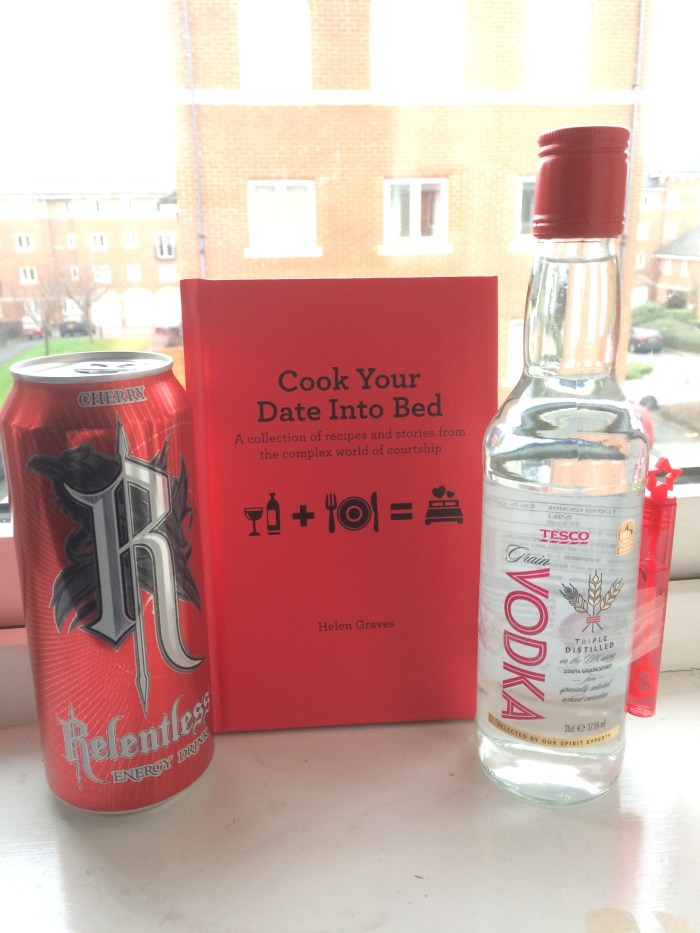
(See what I did with the bubble wand? After a bottle of vodka that bubble wand is going to be the greatest thing since sliced bread.)
I know right? Best damn girlfriend there is.
To be honest this wasn’t quite what I was expecting when I hit the dreaded ‘writer’s block’. For years I’ve been able to type away, through thick and thin, and yet I’m now sat behind a screen not knowing what to do. I knew it had to come at some point, I just didn’t expect it now.
Let’s make this clear, the writer’s block I *think* I’m currently facing is not due to lack of ideas or inspiration. That is very much not a problem right now (unless you can count an overabundance of ideas as a problem). The problem is more that when I type something the words feel dry, as if they lack energy or flavour. Out will pour multiple paragraphs of content, then I look back at it an hour or a day later and just want to delete it all. It is unfair a comparison to make, but it feels like some kind of post-natal blog depression. Some days I can’t even bear to write something new, for fear that it will never match up to my demanding standards.
There’s no need to consult a doctor or Google over this text-based disease, I know exactly where it stems from and why it’s not something that can be cured overnight. Over the past couple of months I have ploughed as much time as possible into writing a novel. Not just any novel, the novel which I have been telling myself I am going to write for quite literally years. I’ve worded and reworded the synopsis hundreds of times in my head since I was seventeen years old and, like this frustrating itch or swelling lump on my body, I feel like I can no longer deny myself and my mind the injustice of not putting these thoughts into black and white. I need relief. For many nights I have woken up in cold sweats having seen the lead character in my dreams and I find myself frequently walking past colleagues blindly just because instead of seeing them, I see the scenes of an unwritten novel play out right in front of my face. You may think me romantic for saying these things, but it’s all completely true and happening right now. The mind my a beautiful thing, but it is by no means simple to understand. Needless to say my novel needs writing, if not to free me from fictional torture.
This is where the difficulty comes in. The novel I’m writing is not all sunshine and rainbows. It’s not a comedy, but it’s dystopian. If you’ve never come across the genre before then think titles such as 1984, Brave New World, Handmaid’s Tale. They’re books which relate to a fallen world, one which has strived for perfection but failed. This where the blog gets heavily impacted because, on top of work, life and investing heavy amounts of time writing a dark storyline, it is difficult to be upbeat and funny with the little remaining energy I have to write the blog.
So you’d think therefore the novel would be the best dam thing in the world, that Nobel prize winning literature would be flowing like rivers from mind to PC. It really feels like it isn’t. My hope had been that by reading other novels I’d be inspired in my writing style and tone of voice but instead I feel pig-sick. I (wrongly) convince myself that I could never write anything as good as my literary predecessors and I even start doubting my own storyline. Despite having it rattling around my brain for seven plus years I find myself questioning if what I have really is a solid story. “Surely someone would have written this already if it was any good?” At which point I glance back to my open Word document and feel empty and the sight of pages stuffed with text.
This was not what I expected from writer’s block. This unfounded self-loathing, self-criticism, mild self-disgust. I think to myself that I should stop reading, but I then shake my head of this thought. To tell a writer to stop reading really would be literary suicide. Another recommended fix would be to get someone to read my work, but I can’t even bring myself to do that and then I get angry with myself for not taking the pride I should in my work. And thus the endless bitter circle repeats itself once more. I said it above and I’ll say it again, there is no quick fix to this. Based on this acceptance I’m therefore going to adopt the third way, to keep writing and editing and writing until I shake off all these negative thoughts. Tackle the problem ‘word on’ so to speak. After all, 1984 wasn’t written in a day and I’m pretty sure Orwell didn’t publish his first draft. Let’s get words onto paper and go from there. You can do this Alice, you can dam well do this.
If there is one thing to take light from this unpleasant situation it’s that, in developing a form of writer’s block, I finally feel like I am becoming a serious writer.
The rain rolls down the cold, hard, glass of my little bedroom and I find myself pondering on the topic of ‘replacement’, debating in my equally little head what the term actually means.
Grey clouds sit high above in a content fashion. On this drizzly January evening it’s hard to imagine that anything else could possibly occupy these temperate British skies. Only occasionally are the plump objects forced to move on, being replaced by a substance more yellow and warmer in personality. One would expect the ants below to rejoice in this uncommon of events, yet the reaction is ironical. Instead of being celebrated, hailed and praised, the British will complain. We’ll moan that it’s too hot, or complain that our offices are insufferable, some will even complain that it’s bad for our health. I can predict the headlines now “Sun Sizzles Cells!”, “Cats Fainting in Cumbria!” (or words to that effect). But, until that happens we will all sit in the gloom and sniff and cough until a suitable replacement is found. We complain when it’s cold, tut and sigh when it’s hot, that’s just how we are. Just as the sun is characteristically warm, our Island is habitually cool.
My gaze moving now from the window, I look across my room until my eyes fix on a plastic storage unit, my plastic storage unit. Complete with bugling drawers of linen, stationery and books, I smile at the thought that my life can be summed up by the very existence of this cheap short-term, turned long-term, storage solution. My necessity to collect the trivial but essential fuels its existence. However when the time comes to move it will, at best, be relegated to a dark corner or, at worst, disposed of entirely. In short, it will be replaced. It’s years of service will mean nothing. Utilitarian style is after all so 1941. In the history of never has anyone ever shown off a £15 storage cabinet to visitors. It has skills, it has done me no wrong, but it is ugly. Like the grey skies above me, it must be replaced.
The books stacked on top tell the stories of fictional individuals, but they also whisper unwritten tales of the reader who studied each page so very closely. They speak, to pardon the pun, volumes. The reader has laughed, cried and everything in between whilst flicking through the dog-eared pages of these novels, sat on the plastic storage unit. I happen to know her very well. And yet, they have been read now, the stories seen, the lessons learnt, which is why they now stack up in an ever growing pile. There is no space to put them anywhere else. They used to look pretty, create the feeling of an intellectual figure who reads a lot, but now the reader has had enough of these books, she bores of them. Overnight the stack has turned from romantic to repulsive. Yes, new books are needed, but the old ones must be given new homes. They may be of a different breed to the generic storage unit, but then surely one book is as good as another? After all they all have jackets and pages, what are a few differing words? Yes, the old needs definitely needs replacing with the new.
Isn’t it funny how a seemingly harmless word can be, well, so harmful? So insulting and damming. ‘Replacement’ is not a term that fills one with optimism. To replace someone or something is to hope that their successor does an equally good job with an additional quality or characteristic that is more appealing. Failing that, one hopes that the replaceor can do the same job, at the same level, with no complaint. No one ever asks for a ‘lesser replacement’. I want the sun to come out, but yet my lifestyle won’t cease to continue if it remains grey for the next six months. I want a prettier storage unit, but I don’t want it to fall apart on day one. I want a new book but I don’t want it to be full of nursery rhymes.
I have heard people say “anything can be replaced if you look hard enough” and then witness these same people grumbling as they struggle to find a healthy, tasty, alternative for chocolate. If everything was replaceable then wouldn’t all food be the same, all objects identical, all creatures predictable? The uniqueness of life itself is what makes our planet as beautiful as it is and what makes each ‘thing’ unchangeable.
Nothing is truly replaceable.
(Written in response to the Daily Post Replacement)
Click below to read the controversial article that has sparked comments such as “Born and Bred Here. Even I say the Town is Crap”, “It’s like Syria with 99p shops” and, my favourite, “This is a poorly written article with a plethora of spelling errors”.
http://www.theswindonian.co.uk/20429/262176/a/girl-about-town-swindon-town-centre-in-review
 My Housemate's a Mermaid