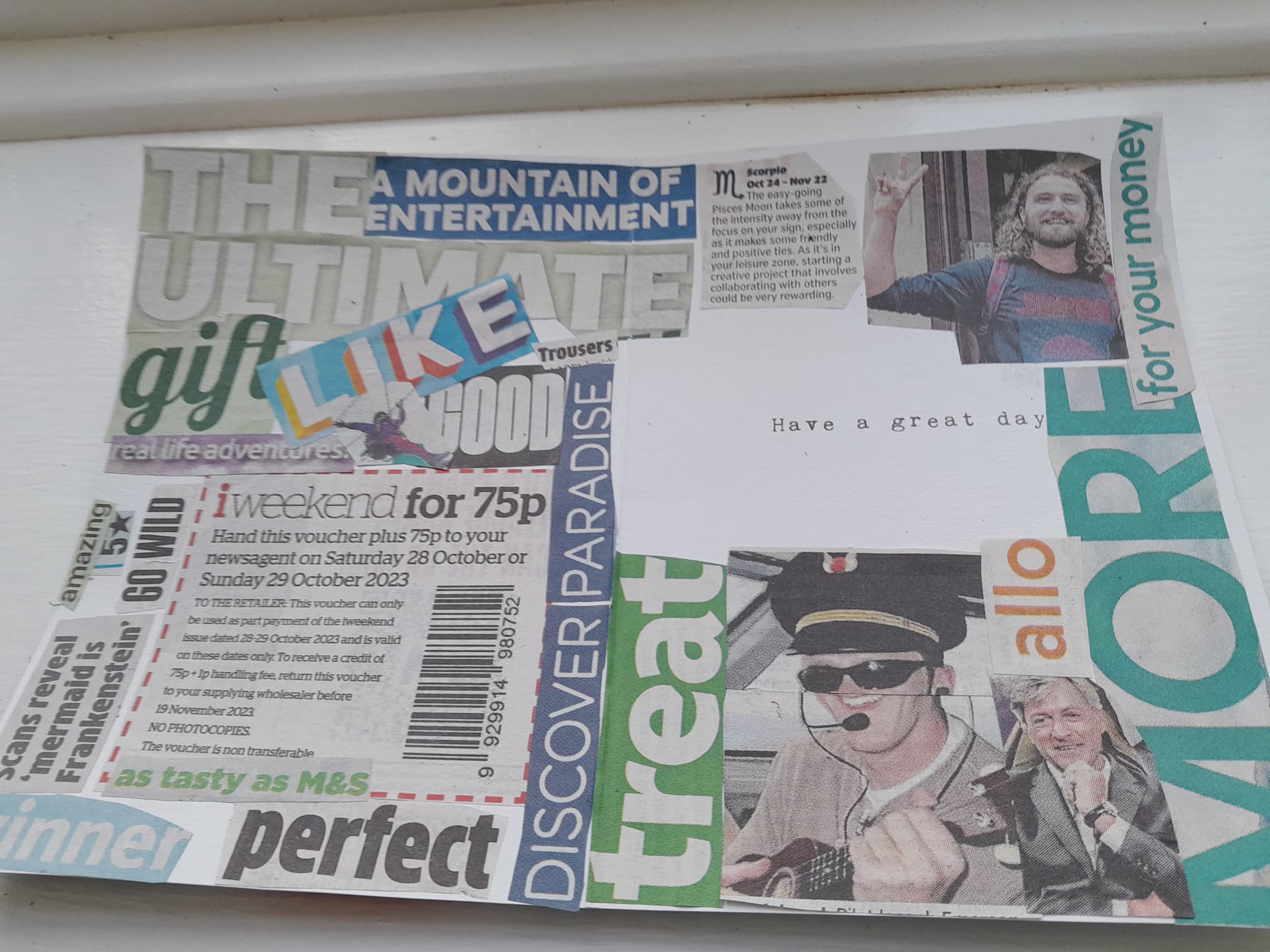
From the makers of Seven Degrees of Pie, ladies and gentlemen, I present you with the collage-card I gifted my sister for her birthday:
Now, I know how it looks. It looks like I found a really old newspaper, cut it up and threw it altogether to squeeze into a birthday card…
In my defence, I didn’t realise the coupon for the iweekend newspaper was dated.
Besides, who couldn’t be left in absolute awe over the contents of this birthday card? It has words such as “amazing”, “5*”, “Discover Paradise”, and a inserts of a pilot with a ukulele and Richard Madeley with a knowing smile.
I obviously threw in some smudgy words into the gap before handing it to her, but we all know the real reason why it’s a birthday card she won’t forget in a hurry. After all, you know what they say, “don’t judge a [generic greetings card] by its cover.”
**
Could you spare a dollar to support me? Donate here!
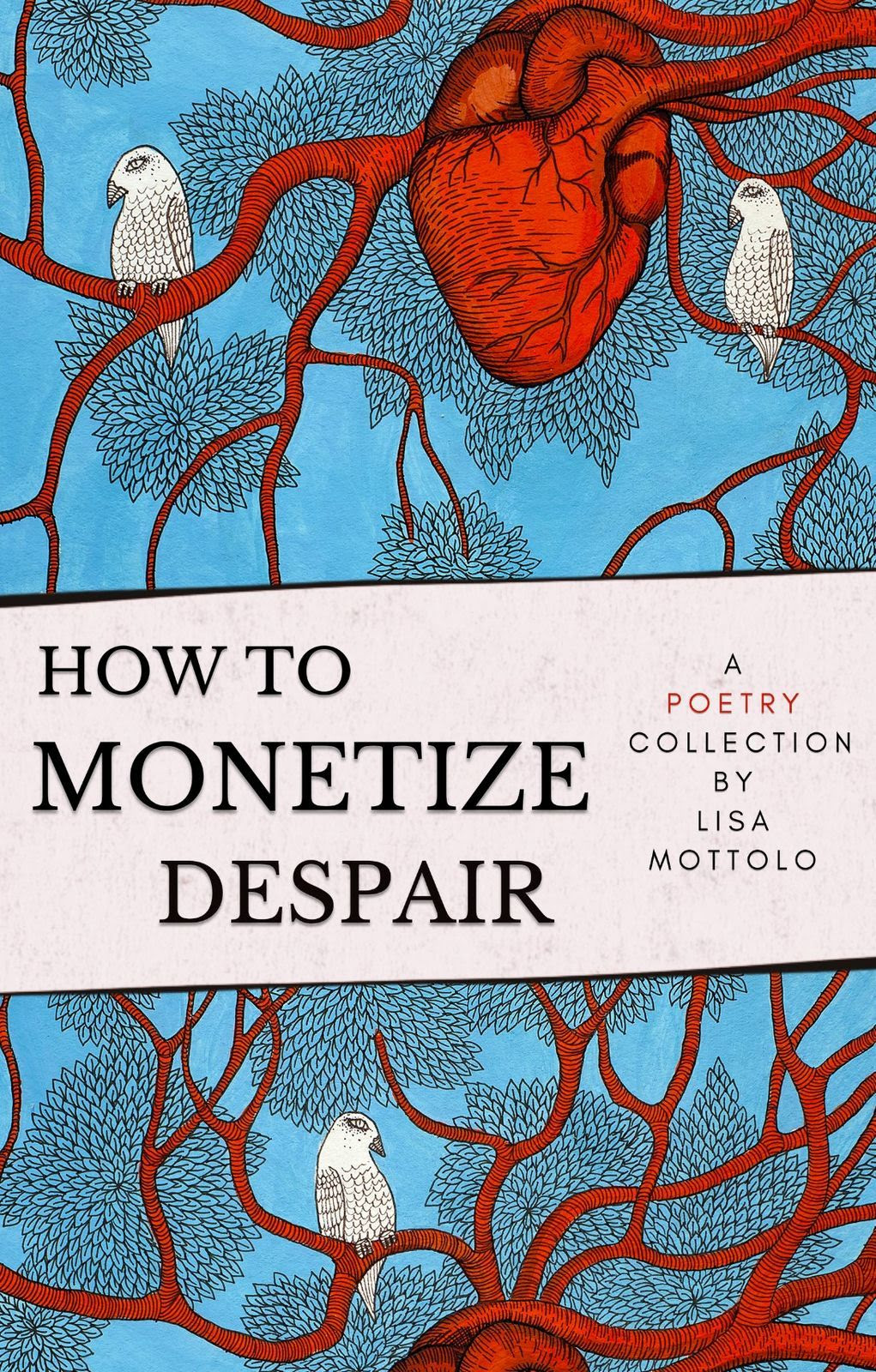
Headline:How to Monetize Despair: I don’t know how Mottolo does it, she just does.
Review:
Before I have even turned the opening page of How to Monetize Despair I somewhat know this is going to have me hooked. With an intriguing choice of title and dramatic cover imagery, Lisa Mottolo’s poetry collection is one which marks itself as bold and unapologetic from the get go. Those of a sensitive disposition should step aside now.
In just under a hundred pages, this collection provides readers with an assortment of stanza-led poetry and monologue segments, divided into three segments but overall covering the key milestones of grief, from the initial shock trauma to forming new pathways in life. In one poem titled “We Only Speak Well of the Dead”, Mottolo inserts feelings love and compassion expressed in the wording against a title backdrop of dry humour (in this case, the observation that so often death blesses one’s legacy with a celebrated status which the deceased are unable to appreciate). It is a slightly twisted view of the world, but one which feels clever and, like much of Mottolo’s poetry, one you need to read for yourself to truly appreciate.
The monologue excepts of writing are monolithic, taking up to a page with the author intentionally leaving the copy as one lump of solid text. It forces the reader to tackle the content in one go, or else face losing their place in the text altogether, however once you adopt the differing approach to reading you are greatly rewarded with beautiful imagery and ideas on the meaning of life that for better or worse will haunt you long after you have finished reading.
How to Monetize Despair makes for a strangely captivating read. It is hard to put into words how Mottolo does it, she just does. In truth the only way to fully understand this poetry collection is to read it for yourself, do that and then we can talk.
Hello, present-day Alice here. I found this post deep in my draft archives, 2021 deep. On one hand I have no idea why it never got posted, and on the other hand I have every idea.
While some things have changed since this was first drafted (notably the fact I was very much single in 2021), you’ll be pleased to know the cooking skills are still as horrific now as they were then. I did it then, and I have no doubt I’d do it all over again if given half the chance…and a courgette.
So, that in mind, enjoy. AEB
**
You know how when someone says they’re a fat person in a skinny person’s body, you nod along? Well, I am that person, the one who doesn’t understand how she’s not yet stuck in a doorway.
I honestly think the only reason I’m still a healthy weight is be because I’m a slave in the Matrix, and the aliens are milking me for battery juice. (It’s a normal thought process to have, right?)
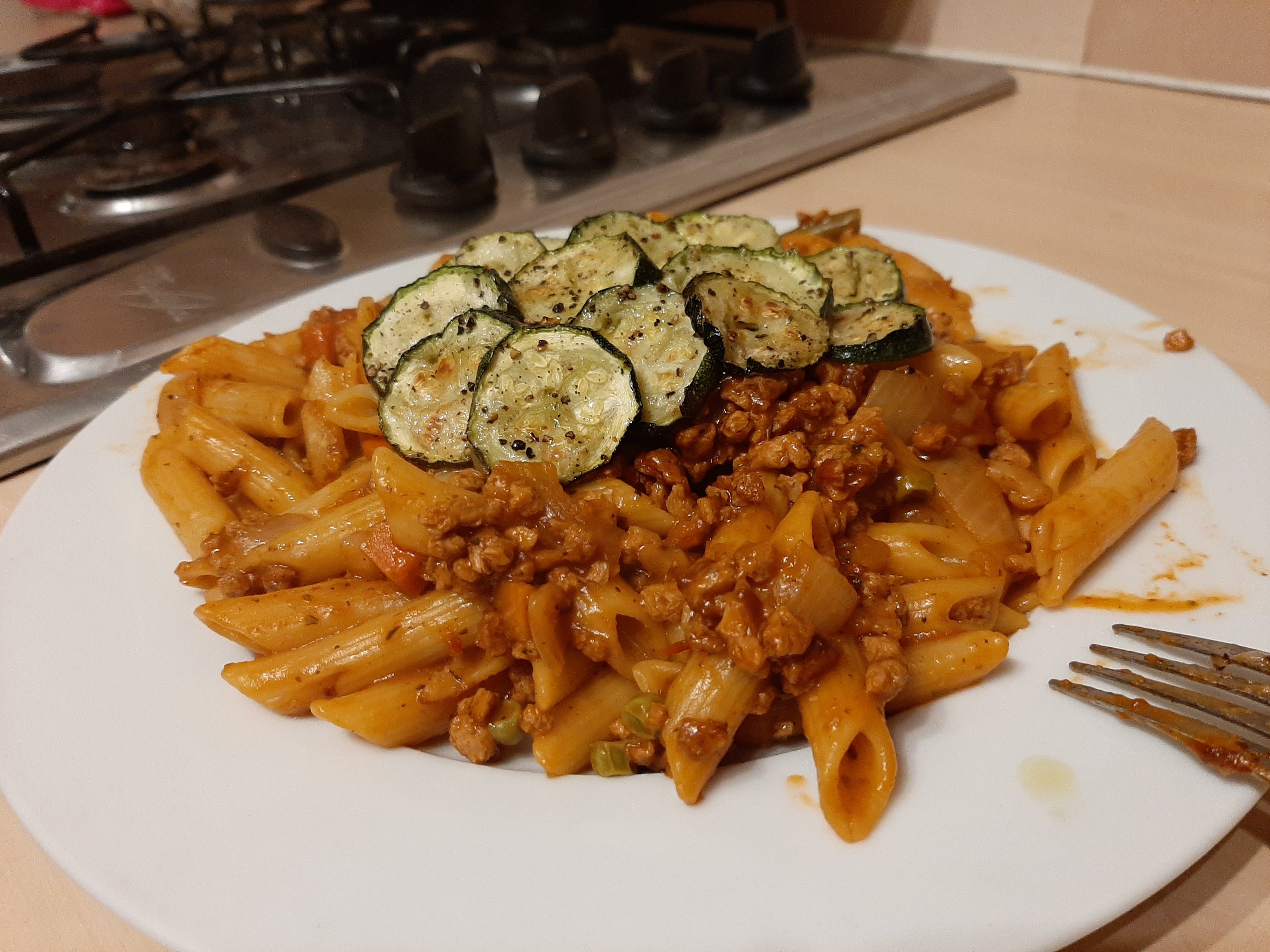
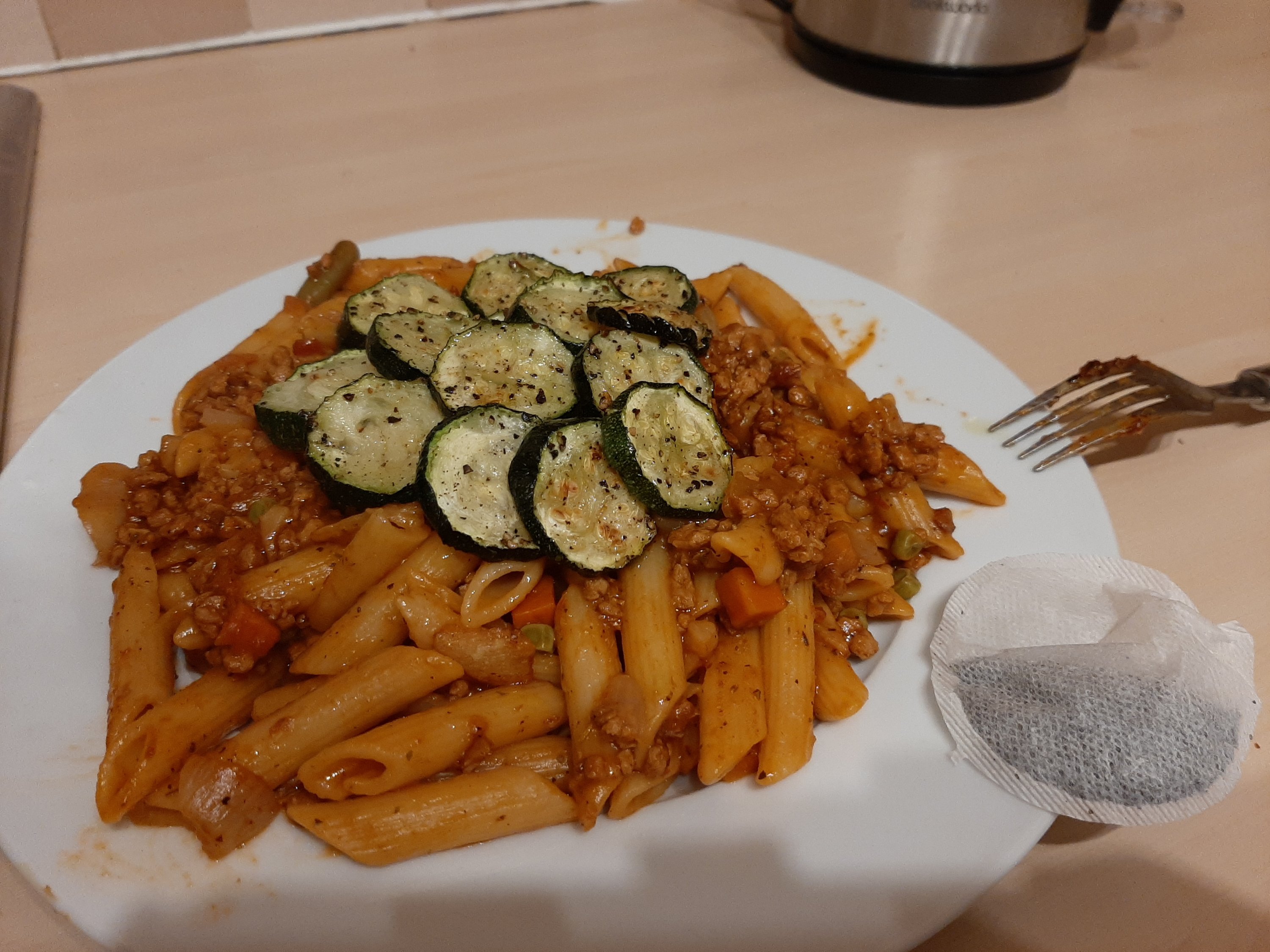
Take this evening and my portion control when it comes to this mass-produced Quorn Spaghetti Bolognese:
(FYI, not a vegetarian, just trying to do my bit for the planet…and stop Paul McCartney coming after me.)
And yes, there are also frozen vegetables in there, but let’s not dwell on the lengths I go to to ‘stodge-out’ a meal.
The thing is, it was a perfectly normal* (*Alice’s version of normal) meal. But then I had this courgette. And the courgette was on the turn (it was a little bit squidgy), but it was something Mumma B had given to me, so I was determined to not let it go to waste. But the mince-stuff was already cooked and rapidly burning.
Basically, I panicked.
I hurry-sliced the courgette, coated it in black pepper, drowned it in olive oil and then threw it in the oven. I don’t know why, I just did. And even as I type this, I am very much aware this is an Alice-world problem.
Anyway, about ten minutes later (Married at First Sight was on and I may have got distracted), I retrieved the cooked-baked mush that was once a courgette and dolloped it onto my dinner plate. By now the pasta was stodgy and the mince mostly burnt on the bottom of the pan. To add to this, I didn’t quite feel satisfied that the first picture illustrated the large portion of food I had on my plate. So what did I do?
Yes, that’s right, I compared it to the size of a teabag.
This, this is what I do for content. Jeeze.
**
Could you spare a dollar to support me? Donate here!
Headline: Merging fiction and memoir, Foxwell’s self-help guide is insightful in places but muddled in others
Review:
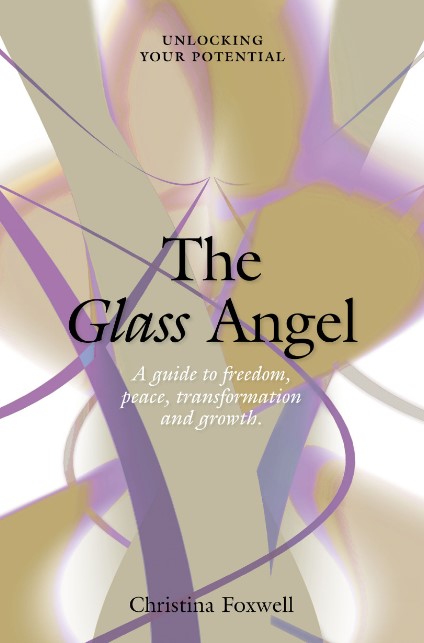
The Glass Angel is a book of three Acts. In the first, author Christina Foxwell presents a fictional tale of a glass angel who experiences hardship after she damages her wings in a storm. Immediately following this comes Foxwell’s revelation that the glass angel in her short story is a metaphor for her own traumatic experiences growing up in a strict Cristian community during South African Apartheid, including her abusive marriages and challenge of being a single mother. The third and final act introduces self-betterment activities for readers including how to turn negative “moth thoughts” into positive “butterfly thoughts”.
This book pitches itself as an informative self-help guide, yet the opening third, with fictional tales of fantasy and magic, is bewildering (pun not intended). My honest thoughts while reading this section were why is this story here and why am I reading it? A short story through and through, “The Story of Alchemy and Transformation” reads like a bolted-on piece of copy which should have been published separately. Compare this to the autobiographical element of this book, which contains by far the best content for its ability to draw at raw emotion, and it is easy to identify where Foxwell’s skills truly lie.
While some chapters could have been tightened with the assistance of a professional editor, others were desperately lacking. So much more could have been expanded on Foxwell’s personal relationships with friends, her domestic servant and even the church. This would have come into its own in helping highlight the fallout that came following the separation with her first husband, the protection and safety those secondary relationships offered. It impacts on the rest of the book; you almost feel cheated when areas are skipped over in haste, almost as if Foxwell would rather not dwell on certain topics and move swiftly onto the author/reader exercises towards the end of the book. As a result, there is a sense of lacklustre to complete the activities on the reader’s part, like being hurried into the giftshop of a tourist attraction thirty minutes before close.
The age old phrase goes “write what you know about” and in this instance Foxwell would have done so better by herself and readers to have sold us a hard-hitting memoir of her triumph over adversity, not a self-help guide.
Headline: In attempting to drive home a serious message about climate change, this short story feels a bit flat
Review:
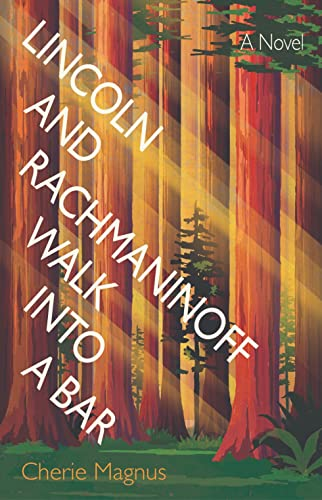
Lincoln and Rachmaninoff Walk Into a Bar by Cherie Magnus is a short fantasy, following the adventures of an unnamed narrator as they race across America to save the world from the perils of forest fires and climate change. Their quest is supported by a cast of comrades living and dead, notably including former American president Abraham Lincoln and the Russian-American composer Sergei Rachmaninoff.
As far as plotting is concerned, this is not a particularly well thought-through book. The overall premise of Lincoln and Rachmaninoff Walk Into a Bar is somewhat questionable and the triggering incident is not introduced until about halfway through the story. This comes after a succession of scenes where characters talk about their past achievements while trying to comprehend modern technology in the 21st Century. Only when a spiritual figure appears to inform Rachmanioff and Lincoln they are to compose and write the lyrics for a song to save the planet does the story start to develop a sense of pace. It is a plot that is never fully realised, at least not in a way that provides a satisfactory conclusion.
The first person narrator’s statement in the opening lines that they had a dream they met Lincoln and Rachmaninoff rather sets the tone for the rest of the book. The dream statement is touched upon several times in the story, yet there is no moment of “and then I woke up”, leaving readers to guess for themselves the blurred lines between what could be reality and what could be a dream sequence. Is the whole story a work of character imagination?
The book has a lot of grammatical and spelling mistakes and the overuse of unnecessary adverbs becomes very grating, very quickly. There is also a strange subplot in the story where Destiny, a music student, and Lincoln strike up a flirtatious relationship. This part may have been intended as comedy but instead it feels more uncomfortable than funny.
The intended climate change message of Lincoln and Rachmaninoff Walk Into a Bar is lost in its poor execution. It is not to a high enough standard to recommend it to other readers, even if the historical research is commendable.
Headline: After reading this book, you will never see a story in the same way again
Review:
Story and Structure: A Complete Guide by Leon Conrad breaks down the key components of each of the eighteen types of story structure into its constituent parts.
An editor and creative consultant, Conrad’s previous experience makes him no fledging when it comes to the study of writing. Introducing a broad range of tales, from well-known folk stories and Greek mythology to short stories hailing from India and Japan, Conrad draws on patterns in storytelling, highlighting the similarities, patterns and traits within the various story types. Each chapter is introduced with a charming illustration by the artist Jason Chaung and a summary definition (some story structures being easier to define than others). After summarising a tale that deploys the story structure (e.g “The Three Little Pigs”), Conrad dives into a microscopic study, dissecting the elements of its structure.
The use of illustrative symbols plays a significant role in this book. In fact it is probably truer to say that without use of George Spencer-Brown’s calculus, Story and Structure would cease to exist. Conrad deploys a multitude of symbols within a table format to highlight the key twists and turns in different stories. Beginning with the traditional Quest structure and its six illustrative symbols, Conrad gradually introduces new terms and symbols to break down increasingly complex story structures. In the “Trickster” structure, discussion expands to analyse the developmental arc of multiple characters. As if by magic, one straightforward folk story suddenly becomes three multi-dimensional and interwoven tales.
Initially the use of symbols and tables can come across as overwhelming and complex to understand. However with each structure type you begin to to better interpret and translate the symbols. After reading the book once I returned to some of the earlier chapters and found the detailing to be more self-explanatory.
Conrad’s guide to story structure should be treated as a top-shelf reference guide for anyone wanting to study the art of story structure as opposed to a quick flick before bed. With this book, perseverance is key, after reading Story and Structure: A Complete Guide you will never interpret a story in the same way again.
As a little nod to some of the many hundreds, thousands, millions of independent coffee shops in the world, I’m going to do the odd coffee shop shout out to celebrate all the wonderful things they do, in and around caffeine.
So it’s a big, fat shout out to Darkroom Espresso in Swindon (Wiltshire, UK). A trendy little spot just outside the town centre and one that has never judged me for sitting in the window with my laptop for two hours. (That alone is worth its weight in cappuccino gold.)
If you’re in the area, check them out.
**
Could you spare a dollar to support me? Donate here!
Headline: With too much head-hopping and an overuse of confusing metaphors, The Golden Apple missed the mark for me
Review:
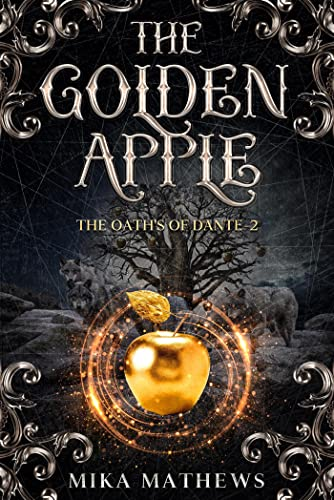
The Golden Apple by Mika Mathews is the second book in the young adult, Fantasy, series “Oaths of Dante”. The story follows on from The Silver Coin with the protagonist, Dante, awakening to find himself transformed into a wolf. Seeking out the famed golden apple to restore peace and balance to the world’s magic is no small task, but accompanied by a gang of accomplices and the magic of Gaia pulsing through his veins, Dante is ready to tackle the next challenge in this thrilling quest.
There are likeable elements of this book. The personality traits of each wolf character certainly help to make the story more colourful; Dante’s sexuality and the character of Cypress (as just two examples) adds needed diversity into the story in a way which is reflective of the wider world we all live in. More of this, please!
The Golden Apple‘s biggest weakness is in its execution of narrative voice. The book is written in third person omniscient (as a reader we see everything taking place at any given time, as if were were a god-like figure). The story’s primary focus is on Dante and his hunt for the golden apple, yet there is so much head hopping it soon becomes incredibly hard to form a relationship with any of the characters. Really the author should have tackled this book in close third person, focusing specifically on Dante’s inner dialogue, feelings and reactions, and blocking out those of all others.
There are also a number of expressions didn’t quite hit the mark for me. Expressions such as “unbearably beautiful laughter” and “Gaia’s majesty flowed through her…subtly and with great love”. There are a lot of them throughout the book and in the vast majority of cases they come across as one liners that may have sounded good in the author’s head but less so for readers.
In truth this book may have been better if it had been merged with either the first or third book in the “Oaths of Dante” series. At only 121 pages long the word count is a bit slim for the expectations of this genre. With strict editing (ideally from an experienced professional) The Golden Apple could shine as a secondary plot of a bigger story arc, however right now it is not something I will be rushing to read again.






 My Housemate's a Mermaid