I’m very excited to announce that my short story, “Bee Happy”, has been selected for inclusion in Swindon Writing III.
A locally championed publication, Swindon Writing III showcases and celebrates the broad range of creative talent which exists from within Swindon and further afield. I’m told the standard was incredibly high this year, with an unprecedented number of submissions, which is all the more reason to celebrate this achievement.
As you can imagine, this update has put a further spring in my step and made my heart sing. I can wait to see my words in print and share with you a snippet of my creative mind.
Swindon Words III is published today, 30th April 2024. Details of where you can purchase the anthology will be shared as soon as I know more!
**
Could you spare a dollar to support me? Donate here!
Headline: Whether poetry is based on true events or the work of utter fiction is irrelevant when it’s as captivating as this
Review:
Penned by the biracial, bipolar and bisexual poet Quazaye Konkel, Bubblegum heart & other elastic things is a collection that take readers on a story of love won and lost. Beginning with the initial feelings of passion and lust that come with any fledging relationship, Konkel moves through the lines of the opening poem “venus de milwaukee” with ease. These joyful moments are shown in subsequent poems, perhaps peaking with “bubblegum heart”, a midpoint piece where the narrator declares their love for an unnamed individual. By the time readers reach “jinx” there is already a sense that something is going wrong, that the relationship is unravelling and spiralling out of control.
“I didn’t mean to jinx it // when I asked if you were // okay… // I only meant // to kiss it // better”
But even in the lows there is much to be grateful for. In “seasons of loving”, readers are presented with an individual reflecting on the positives of a failed relationship as much as the negatives that ultimately led to its deterioration. It is beautifully written and fitting closing poem for this charming collection.
There is a lot to like with Konkel’s collection, particularly in the strength of the narrator’s voice which follows through all of the poems. The reader is transported on a journey and in doing so builds a strong relationship with the narrator, almost as much as the narrator does with its unnamed love interest. The pacing is good and the varied use of poetic forms keeps the mood and tempo engaging.
It is not often a collection of poetry focuses on one narrative voice working through a linear journey but Bubblegum heart & other elastic things succeeds in captivating readers in a story of joy and struggle. Whether poetry is based on true events or is the work of utter fiction is irrelevant when it is as captivating as this.
Not wanting to toot my own horn, but, I’m going to toot my own horn.
The looks staff gave me coming along with my trolley, approaching the self-service tills with thinly disguised smugness usually reserved only for the scan as you shop crowd.
I see your tiny space for basket shops and I raise you this:
(Although not going to lie, I was annoyed I couldn’t get the ice cream fully onto the scales.)
All the years of playing Tetris have clearly not been lost on me. And if you want the best words of guidance for getting staff to walk on by, wearing a face covering and buying a pack of cold relief medication will go a long way.
**
Could you spare a dollar to support me? Donate here!
Headline: The use of AI illustrations opens up a can of ethical worms in this wordy picture book
Review:
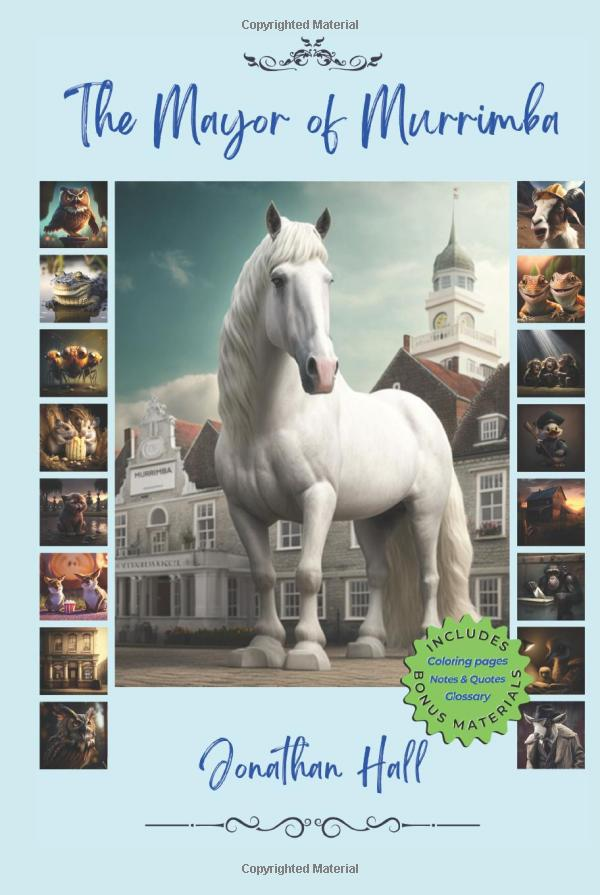
The Mayor of Murrimba is a children’s picture book by the Australian-born author Jonathan Hall. The story revolves around Shelly McGee, the much loved equine mayor of Murrimba which is inhabited by a range of colourful animal characters. In Murrimba, the mayor can only run for two terms after which the townsfolk must vote for a new mayor. With big horseshoes to fill, who will be the victorious successor to Shelly’s reign?
While pitching itself as a picture book, it is hard to know exactly what audience The Mayor of Murrimba is pivoting itself towards. The large amount of words per page suggest an older child demographic (age eight – ten), whereas the large number of colourful pictures are more common in books read by younger readers and their parents. The introductory section which describes how to read the book is confusing, longwinded and shouldn’t be needed in a picture book. Within the body of the story rhyming couplets come across as forced at times and the need to footnote explanations for some of the more nuanced references just seems to miss the point. For example, a meaty paragraph to explain the history of the Dickens classic “A Tale of Two Cities”.
All of the illustrations are derived from artificial intelligence (AI) software. AI generates illustrative content by scouring the internet which, while on the surface might seem like a nifty hack, its has also become the subject of multiple copyright lawsuits. This, after claims that AI generators steal the work of artists and fail to pay royalties for the subsequent use of the output. If you take a second glance at the images in this book it shows, from bears in clown costumes holding a single balloon to insects with oversized honeycomb eyes, some of the images are quite spooky.
To make this book of a engaging standard, the author needs to rethink the amount and complexity of the copy. The story arch needs to be workshopped to improve the pacing, sent to parents and children for feedback and refinement. A skilled children’s artist should be brought onto this project to produce the illustrative content, even if it means reducing the overall page length to balance the increased production costs.
The use of AI may open up new doors, but using it to cut corners on design is not something that will sit easy within publishing.
Judge and Bournemouth academic, Charlotte Grace Fodor, said of the piece:
“How the Dressmaker of Bournemouth Feeds her Family” is a well-crafted, thought-provoking story with good attention to detail and is glittered with humour. I particularly enjoyed how the ending of the story adds depth and layers to the narrative, prompting the reader to reflect on themes of self-expression, transformation, and authenticity. The question posed by the shopkeeper…invites the reader to consider the choices we make in presenting ourselves to the world.
This question can be interpreted in various ways, encouraging introspection about personal growth and self-discovery.
Needless to say, I am completely over the moon by this news. Given the hundreds of submissions into this competition, I was more than flattered to have made the longlist, let alone the top 20. That in mind, I want to congratulate all of my fellow longlistees and thank all those involved in running this competition.
I’ll be joining my fellow winners for a special awards ceremony taking place as part of the festival later in April. Watch this space for updates!
Lines in the Sand will be published by Dithering Chaps on 26th April 2024. It is available for pre-order from Amazon, with physical copies available during the festival and from the publisher direct.
**
Could you spare a dollar to support me? Donate here!
Headline: This book succeeds in breaking down stigma and rebuilding it with positivity and confidence
Review:
They say only two things certain in life, death and taxes. If my recent reading has reaffirmed anything, it is to only reinforce that that phase was very much penned by a man (I’m looking at you, Benjamin Franklin). Because, for half the world’s population there is another inevitable life stage, the menopause.
On the surface Melissa Ann’s guide, Control Menopause Before it Controls You is something that screams “female only, men barred!” (and for what it’s worth, the cover design doesn’t help). And yet, this is a guide that could, and should, be read by all genders or all ages. In circa 150 pages, Ann’s book covers all three stages of the menopause: perimenopause, menopause and, finally, post menopause. All three stages are then broken down into guidance, including the bodily changes to expect during and lifestyle improvements that can lessen symptoms. Guidance even goes as far as to recommend particular food categories and exercise routines, spiritual activities to try out and conversations to have with partners.
It this latter point which makes Control Menopause Before it Controls You universal to all. While some sections specifically call on the need for open and frank conversations, it is hard to find any aspect of the book that wouldn’t benefit men in terms of improving their understanding of such a key life stage for women. After all, these are not just the female partners, they are the friends, work colleagues and family members of their male counterparts too.
Discussions around the menopause have come a long way in recent years. In the office I can barely make it ten yards before being hit in the face with a promotional flyer for an upcoming talk on women’s health. It is an improvement, make no mistake, but we still have a long way to go. This is book, with its engaging tone and inclusive terminology, is a good place to start.
Ladies and gentlemen, I present to you the 2003 Christian epic “Joshua and the Promised Land”
Image credit: IMDB
But don’t take my word for it (and the high quality design of the DVD cover), check out the film for yourself.
Yes, I am twenty years late to the party. Probably because the creators had tried to bury it.
For those without an hour to spare, here’s a three minute compilation of highlights (although not all off them, otherwise the video would be the same length as the original).
The reviews left by viewers make the 60 minutes of torment all the more worthwhile. Take these examples lifted from Amazon (where you can currently buy a copy of the DVD for c. $190):
5 Stars- This movie was the best that has happened from Christianity. This movie single handedly saved my marriage, better than the Bible you don’t even need to read the Bible after watching movie great for kids to experience Christianity through the best media possible!
5 stars – Me and my wife were considering a divorce prior to seeing this film. We were going through some tough times after we lost our 4th child, Jimothy. Jimothy was the glue that held our “little” family together. After he died, my wife and I just didn’t see each other the same. Then, on one glorious day, a package came to our door. It came in a box, a simple box, there were no special markings or distinguishing figures, just a box. I opened the package and saw what I believed to be a children’s film, I was very very wrong. Joshua the Lion is a tale about adventure, godliness, and most importantly family. After my wife and I saw the mended relationship between Joshua’s parents, we too knew we could save our marriage.
1/10 – This Movie Caused the Great Depression. This movie is so incredibly bad, that it caused the Great Depression. After seeing this movie, people’s faith in companies to provide quality products plummeted. This caused almost every business to go bankrupt, as no one was buying their products. People also lost faith in the banks, as they put so much money into this movie that they had no money to pay back the citizens. This threw the U.S economy into a downward spiral, and left the country in ruins. Overall, I would say that we burn all physical copies of the DVD to get rid of the memories of this tragic time period.
1/10 – Joshua and the reason i ripped all my hair out. This movie was decent until i actually started watching it. This movie made me cry, and not because it was emotional, but because of not only the god awful, horrible, student film quality looking animations, but i was so sad about the 55 minutes of my life that i will never get back, that i am 90% sure that i contracted chronic depression. This movie’s voice acting sounded like Gary Busey with a sinus infection. And what self-righteous 40 year old kindergarden student at the school of animation, thought to themselves, “Oh you know what would be clever? My last name is Lion, so lets make all the characters lions!” This movie looks like somebody decided to make lugaru into a movie and somehow used even worse quality character models than that. Overall this movie is the bane of my existance and i would rather chew gum i found on the bottom of a desk than watch it again.
And so on, and so on.
A few days later I discovered the film had a deleted scene. A deleted scene that makes no sense whatsoever. The YouTuber Saberspark does a great walkthrough of it in a way that makes it just about bearable:
So now you too have this film etched into your collective conscience.
Well…you’re welcome!
**
Could you spare a dollar to support me? Donate here!
Headline: It is sadly game over for this short business management guide to branding
Review:
To use its full title, Level Up! A game plan for entrepreneurs to take their brand to the next level and stand out in a sea of sameness (hereafter Level Up!), is a business management self-help guide by Dutch author Frank Suyker.
Level Up! is broken down into three parts: “Brand and Core”, “Assets” and “Experience”, with exercises introduced in each area to help stimulate creativity, such as brand comparison tasks and word association. Utilising his personal experiences in establishing a brand and of those gleaned through attending various conferences, Suker’s book could be best targeted toward new starters in business, those looking to develop a new brand identity from scratch. At c. 100 pages (with plenty of spacing), it is a quick read.
Despite Suyker’s attempts to make this guide easy and accessible, this is not something I would be in a position to readily recommend to others. The content feels very light on the ground, with factual assertions not backed up with any supporting evidence. For example, “estimates are that there are 30,000,000 businesses in the USA”. In this case, is Suyker referring to a business housing one employee or 1000? Readers placing their trust in self-help guides need to have confidence in the data, including the where, when and what behind the assertion.
This links me to another general comment on this book, grammar and presentation. For a book that devotes time to the importance of colour and imagery, the colours contrast is at points incredibly jarring. Capital letter statements absorbing whole pages in oversized fonts, a list of 50 words which the reader is asked to circle, a task made impossible because said words are set against a black background, a bright orange page with the caption “what does the colour orange trigger for you?” There is a strong reading disconnect with some of the design choices, as a reader you stop reading the content and focus only on the presentation. Level Up! would have benefitted so much more for having had the input of a professional editor and designer.
Deep within the pages of Level Up! there contains some small nuggets of insight. Would it make good content for a website or a magazine column? Yes. Does it make for an engaging book entry into the business management genre? On this occasion, sadly no.
Full credit goes to Pia Guerra and Ian Boothby for this cartoon (lifted from The New Yorker Magazine’s Instagram account) that I know many writers will relate to.
In my case, my “editor” tends to be my boyfriend, and he is a rubbish one. He lets me ramble, resulting in me digging a massive hole for myself and revealing myself to be the utter muppet I am (probably why he lets me do it!)
**
Could you spare a dollar to support me? Donate here!
Headline: Slimmed down a little more, this book could have been a more direct read, without sacrificing quality
Review:
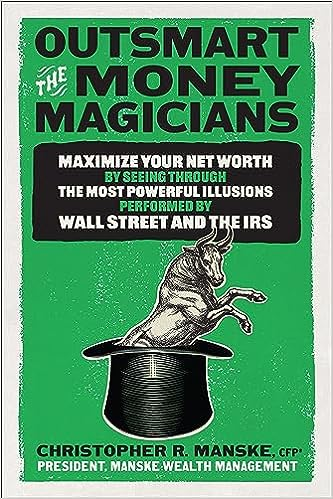
Times are tough, the prices of basic goods are increasing and inflation is shooting higher than the thermostat of my broken boiler. In these most perplexing of financial times, is it truly possible to successfully navigate the complicated world of investments and come out on top? In Christopher R Manske’s recent publication, Outsmart the Money Magicians, the answer in simple; yes, you can.
Spanning nearly 260 pages, Manske leads readers through this prickly subject matter, with the help of fictional case studies and magic tricks to highlight where would-be savers and investors can carefully side step any of the potential risks and potholes.
This book is very informative and Manske’s subject matter and passion for the topic of financial empowerment is clear from the off. Even though the book is written by an American author through an American economic lens, as a British reader it is very easy for me to grasp the hints and tips and understand the general economic principles detailed.
Where I am perhaps slightly less enamoured with this book is in the quantity of words. There are points where it feels like an excessive use of preamble is used to set the scene of the case studies, including the use of contemporary magic tricks which did not always tally up, in my mind, with the black and white financial guidance. Sadly that meant, in places, having to repeatedly read sections due to inadvertently skipping over words. Also, and this could be due to the version I was reviewing, but there are some minor formatting tweaks that need addressing (in the version I was able to review, “<H1>” references existed where headings occurred).
Outsmart the Money Magicians is a good book as an overall package even if I personally I do not feel every word is needed. Slimmed down, this book could have been a snappier and more direct read, without sacrificing the quality of content.


















 My Housemate's a Mermaid