Book Review: “Houseplant Hookups: All The Dirt You Need To Find The Perfect Match” by Agatha Isabel

Rating: 5 stars

Headline: A brilliant concept, offering tongue-in-cheek “dating profiles” for novice houseplant owners

Review:

Sometimes a book just grabs your eye. Maybe it’s the title, other times the cover design, sometimes it’s the blurb jumps out at you. And then I saw Houseplant Hookups. Within seconds I was multitasking, rapidly messaging friends and family as I reached for the book with the other spare hand. They needed to be informed, Alice would not be messaging anyone for as long she was reading this book.

The guide, penned by American author Agatha Isabel (and illustrated by Mai Ly Degnan) is a highly colourful guide on all things houseplant. Summarising key guidance for would-be houseplant owners, the book opens with an extensive section on houseplant care 101. From this, Isabel’s guidance then moves onto the plants themselves, cleverly presenting a variety of different species in the form of an online dating profile. This allows readers to get snappy insights into the pros and cons of various house plants, from the commonly known Spider plant, to the more complex Bird of Paradise plant. This section makes up the core of Houseplant Hookups, but is bookended by a fun multichoice quiz for those still unsure of the right type of plant for them, and a glossary index.

The tone of voice through Houseplant Hookups is highly informal and somewhat tongue in cheek (case in point, the favourite music of a Purple Passion is apparently Prince’s “Purple Rain”). A lot of credit also needs to be given to Degnan’s illustrations, which are gorgeously to look at and do wonders for bringing the concept to life in a bold, fun, way.

While it is not something that I would particularly recommend to an expert gardener, I do see it as the perfect gift to give to a novice houseplant keeper for either birthdays or religious events. The general dating profile style and themes contained within the book lends itself more towards a feminine market.

Houseplant Hookups is a fun book, with a creative approach to an otherwise fairly mundane topic. It engages readers with indoor horticulture and reminds us that no matter how big (or small) the garden, there is a perfect plant out there for all of us.

AEB Reviews

Links:

Reedsy Discovery Review: AEB Reviews – “Houseplant Hookups” by Agatha Isabel

Purchase Link: “Houseplant Hookups” by Agatha Isabel (Amazon)

Author Website: Plant Ma Shop by Agatha Isabel

**

Could you spare a dollar to support me? Donate here!

Alice’s Funding Page

Children’s Book Review: “The Adventures of Nanna Willowspell” by Keele Fishel

Rating: 3 stars

Headline: There were too many short stories in “The Adventures of Nanna Willowspell” for me to get behind the central character

Review:

The Adventures of Nanna Willowspell is a children’s book by author Keele Fishel. Set across multiple enchanting settings, it follows the various short tales and adventures, recounted by the protagonist Nanna Willowspell to a group of children who have gathered to hear her stories. The pacing of this book is driven by these short stories, most lasting no more than a page or two in length, with limited plot outside these stories, which for parents could make this a good read aloud book for much younger children.

While the stories in this book are pleasant enough to read, the basis that all the stories are hyper short in length and unrelated to each other (or the world in which Nanna Willowspell is recounting them) makes the book feel a bit bitty in places. You start getting into a story only to be yanked out of it again. The scene-setting also feels somewhat lacking as a result of the shortness of the stories and the dialogue is limited by the narration of the stories being conveyed in a memory form. While granted, it gives a homely feeling of an older relative recounting an experience, it does remove the development and personality of the secondary characters, however fleeting their appearances might be.

A smaller points on the book’s formatting, where the use of the story’s title at the top of each page in varying font sizes does lend to confusion, it gives the feeling that a new story is starting on each fresh page when in reality it is not always the case. The margins are also too narrow, something which may have been a formatting choice to reduce page count and potential printing costs but it makes the amount of text feel blocky and a tad bit overwhelming.

Based on several hints dotted toward the end of the book, it would seem Fishel is planning to turn The Adventures of Nanna Willowspell into a series for younger audiences. While I love the magical and fantastical elements of this book, in any subsequent books I would prefer it if there was more focus on lengthening the short stories or focusing on the overarching plot of Nanna Willowspell in the hear and now. In simple terms, less is more.

AEB Reviews

Links:

Reedsy Discovery Review: AEB Reviews – “The Adventures of Nanna Willowspell” by Keele Fishel

Purchase Link: “The Adventures of Nanna Willowspell” by Keele Fishel (Amazon)

Author Website: Nanna Willowspell

**

Could you spare a dollar to support me? Donate here!

Alice’s Funding Page

**

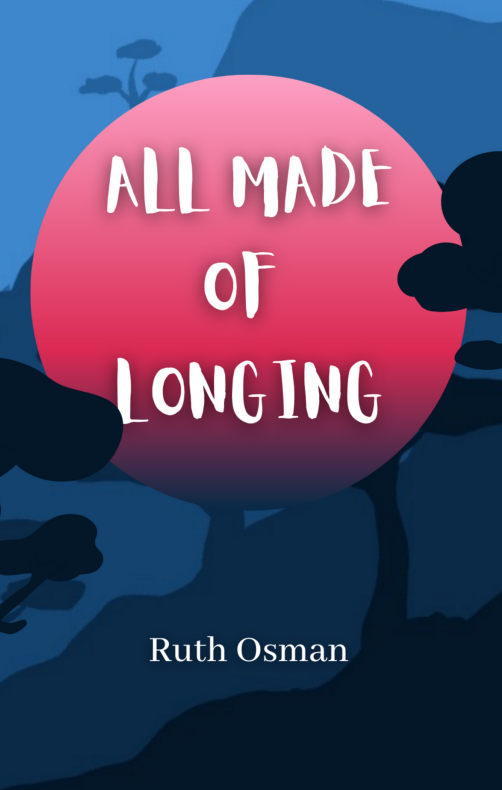
Poetry Review: “All Made of Longing” by Ruth Osman

Rating: 4 stars

Headline: A strong poetry debut which speaks highly of where Osman will take her creative talents next

Review:

There are few mediums that can transport a reader quite so rapidly as poetry. From snappy two liners to elongated stanza blocks, when done right there is something quite magical about the romanticism of the free flowing word and its ability to convey a fresh presentative on the world we live in.

Marking her poetry collection debut, Ruth Osman brings readers to the sunny landscapes of the Caribbean in her new publication All Made of Longing. Spread over sixty four pages, Osman’s poetry draws heavily on the symbolism of tropical surroundings, with an acknowledgement of the human interactions that have come to influence nature (much to our peril).

In All Made of Longing, Osman experiments with different approaches to tempo, pace, presentation and, most significantly, tone. A number of the poems draw on the poet’s heritage and its links to slavery and the slave trade; while they are not always a pleasant read, they are an important read all the same. They suggest sorrow and an ongoing struggle felt by the descendants ever since. As a British reader in the twenty-first century, they serve as an important reminder to the past.

Within this collection, a personal favourite of mine is the short and sweet “Deluge”, a four line stanza that offers a somewhat tongue-in-cheek warning to those who mock the power of Mother Nature. The use of blue monotone illustrations at the header of each chapter is also a nice touch to break up the collection, each a representation of ta tree’s growth, and the ongoing circle of life contained within.

Reading All Made of Longing you would not expect this to be the work of a debut poet, it is a strong opening collection and speaks highly of where Osman will take her creative talents next.

AEB Reviews

Links:

Reedsy Discovery Review: AEB Reviews – “All Made of Longing” by Ruth Osman

Purchase Link: “All Made of Longing” by Ruth Osman (Amazon)

**

Could you spare a dollar to support me? Donate here!

Alice’s Funding Page

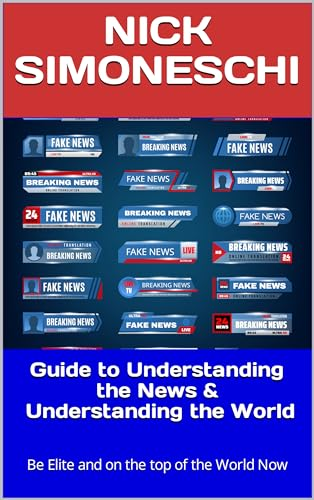
Book Review: “Guide to Understanding the News and Understanding the World” by Nick Simoneschi

Rating: 1 star

Headline: Nick Simoneschi’s guide lacks clarity, identity, and engaging writing

Review:

It only takes a minute, the right author and a dash of luck to make a story go viral. By mid morning, that seemingly biennial news article could not only have become the talk of the office, but the driving force behind behind an entire brand, a new cult or even a shifting force within History itself. Recent years has seen the rapid adoption and expansion of instant media, but can everything we read be trusted?

Written by Law graduate and financial strategic advisor Nick Simoneschi, Guide to Understanding the News and Understanding the World is a non-fiction guide which aims to educate and warn against the perils of believing news coverage at face value. The book is split into seven chapters, covering topics such as “global news”, “environmental news” and “fact-checking”. It is formatted in an essay-type construct, with no additional imagery. Simoneschi refers to the reader as “students” throughout.

While on the cover it seems apparent what Simoneschi is trying to achieve, in reality this is a book that lacks identity. In doing so, more often than not it turns into a soap box for the author to express his views on how news content should be presented. Chapter three, “news literacy for children”, becomes bogged down in arguments for changing the school curriculum, yet it is not clear who Simoneschi is directing this argument to. Parents? Students? Teachers? The intended readership of this title is not apparent enough to know for sure.

The writing itself makes for a very clunky read, with over repetition of key essay buzz words (in the duration of the book’s 81 pages, the word “furthermore” is used 33 times, “conclusion”, 30, and “student” an eye-watering 249 times). The lack of author credentials and general introduction on why the world needs this book right now is also an area which needed presenting in the opening pages of the book. Otherwise it looks like just another opinionated piece anyone could have written.

In a market saturated with other books claiming to be the “definitive guide”, Guide to Understanding the News and Understanding the World does little to shake up the establishment, or offer new insight to a fresh readership base. An experienced book editor would have identified the mistakes immediately and worked with the author to improve the writing quality, to make it a more engaging and inclusive read for its intended audience. Instead, the content repeats over itself, to the point where Simoneschi’s guidance unfortunately becomes too bland to consume in a meaningful way. This book could have been better disseminated as a series of short online blog posts.

AEB Reviews

Links:

Reedsy Discovery Review: AEB Reviews – “Guide to Understanding the News and Understanding the World” by Nick Simoneschi

Purchase Link: “Guide to Understanding the News and Understanding the World” by Nick Simoneschi (Amazon)

**

Could you spare a dollar to support me? Donate here!

Alice’s Funding Page

Book Review: “The Ultimate Beginners Guide To Cheesemaking” by Kendall Roy

Rating: 4 stars

Headline: The Ultimate Beginners Guide To Cheesemaking is a helpful, well-pitched guide for novice cheesemakers, young and old

Review:

Can I just say, I love cheese. It is both simple and extravagant, it’s non-fussy (preparation time for a meal of cheese and crackers? 30 seconds) and, above all, it goes with absolutely everything. There are over 1800 types of cheese, and one of the crying shames of mortality is that there is every chance I will not be able to try them all before the next world beckons. Hopefully that next world also has cheese.

Kendall Roy must be cut of the same cloth as myself. The American writer, based in California, is the author behind the new publication The Ultimate Beginners Guide To Cheesemaking. Spanning 78 pages, this short guide covers everything any budding cheesemaker would need to know to start crafting their own cheese recipe at home. Starting with the origins of cheesemaking, the guide goes on to cover some basic recipes, including essential kitchen ingredients and utensils. The book covers ten different cheese recipes for popular classics, including cheddar, feta and Swiss cheese and is bookended by common mistakes to avoid, and plenty of references should budding readers want to learn more.

A fun book, the tone of voice in The Ultimate Beginners Guide To Cheesemaking is nicely pitched, with the guidance offered at the right level for novice cheesemakers. The recipes are clear (for my fellow readers outside America, an FYI that the ingredient measurement are provided in cup units), and the detail provided on segments such as “essential kitchen equipment” comes from someone who has been there and got the apron. You can tell the guidance is coming from someone with a deep understanding of the craft. It would have been good to have included more imagery (sadly there are none, and in places it does feel lacking for it, especially as an aide memoir for the recipes). There are also no page numbers, which can make it slightly more challenging to when referencing between different sections.

The Ultimate Beginners Guide To Cheesemaking is a good book for newcomers to the cheesemaking industry, and while Roy makes no slight of the patience needed to produce a good lump of cheese, she is also clear on the rewards it can bring. Namely, cheese.

AEB Reviews

Links:

Reedsy Discovery Review: AEB Reviews – “The Ultimate Beginners Guide To Cheesemaking ” by Kendall Roy

Purchase Link: “The Ultimate Beginners Guide To Cheesemaking ” by Kendall Roy (Amazon)

**

Could you spare a dollar to support me? Donate here!

Alice’s Funding Page

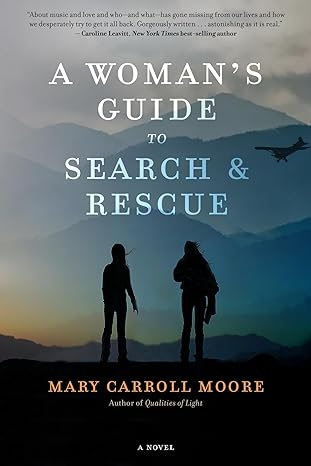
Fiction Review: “A Woman’s Guide to Search & Rescue” by Mary Carroll Moore

Rating: 3 stars

Headline: The story of one woman’s mission to rebuild relationships and clear her name

Review:

When the opportunity arose to review Mary Carroll Moore’s The Woman’s Guide to Search & Rescue I thought I was picking up a non-fiction title (having missed the small inclusion of “a novel” in the thumbnail’s footer). After realising my mistake I decided to continue reading, hooked by a dramatic opening scene featuring protagonist and indie rockstar, Red Nelson.

Shortly after crashing a stolen plane we learn of Red’s predicament. Framed for a violent attack she didn’t commit by the real perpetrator, longstanding criminal Billy Cotton, Red turns to her search and rescue pilot step sister, Kate Fisher and her daughter, Molly, for help. Their challenge is twofold, proving Red’s innocence and locking up Billy for good. However, as family tensions heat up and physical injuries take hold, it quickly becomes apparent there can only be one winner in this epic battle of cat and mouse and, when it comes to defeat, Billy is not a man used to losing…

The premise of this book is interesting, playing against the relationships of blended female generations who are linked by the same patriarchal figurehead. Personalities are distinct between the core characters and Moore does a great job in building tension and raising stakes within action sequences.

In A Woman’s Guide to Search & Rescue there is a lack of strong subplots to keep driving the underlying story of Red evading capture. The need of an additional storyline during the middle lull was particularly needed after the sudden appearance of Billy (an event that occurs earlier in the story than most comparative titles would normally address). This, as well as perhaps a few too many characters within the story, some of which appearing sporadically as means to unlock elements of the plot and little else.

A Woman’s Guide to Search & Rescue is worthwhile a read for those who enjoy stories featuring intergenerational relationships. Moore’s talent as an author shows in the writing quality and scene setting which are well executed throughout. However, in this case, it is the pacing of the story itself that would make me more prescriptive with the type of reader I recommend this title to.

AEB Reviews

Links:

Reedsy Discovery Review: AEB Reviews – “A Woman’s Guide to Search & Rescue” by Mary Carroll Moore

Purchase Link: “A Woman’s Guide to Search & Rescue” by Mary Carroll Moore (Amazon)

Author Website: Mary Carroll Moore | Author and Artist

**

Could you spare a dollar to support me? Donate here!

Alice’s Funding Page

Poetry Review: “How to Monetize Despair” by Lisa Mottolo

Rating: 5 stars

Headline: How to Monetize Despair: I don’t know how Mottolo does it, she just does.

Review:

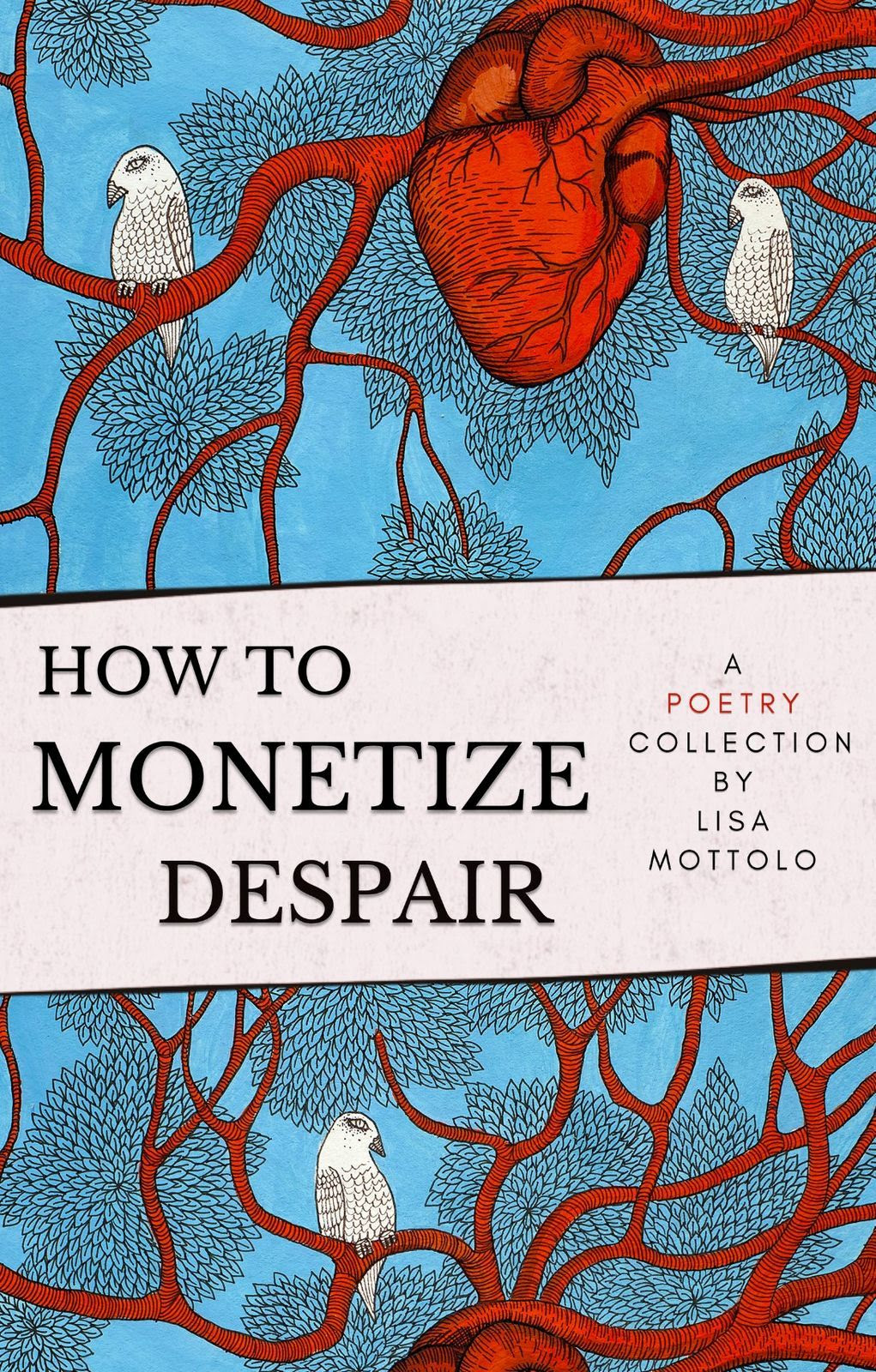
Before I have even turned the opening page of How to Monetize Despair I somewhat know this is going to have me hooked. With an intriguing choice of title and dramatic cover imagery, Lisa Mottolo’s poetry collection is one which marks itself as bold and unapologetic from the get go. Those of a sensitive disposition should step aside now.

In just under a hundred pages, this collection provides readers with an assortment of stanza-led poetry and monologue segments, divided into three segments but overall covering the key milestones of grief, from the initial shock trauma to forming new pathways in life. In one poem titled “We Only Speak Well of the Dead”, Mottolo inserts feelings love and compassion expressed in the wording against a title backdrop of dry humour (in this case, the observation that so often death blesses one’s legacy with a celebrated status which the deceased are unable to appreciate). It is a slightly twisted view of the world, but one which feels clever and, like much of Mottolo’s poetry, one you need to read for yourself to truly appreciate.

The monologue excepts of writing are monolithic, taking up to a page with the author intentionally leaving the copy as one lump of solid text. It forces the reader to tackle the content in one go, or else face losing their place in the text altogether, however once you adopt the differing approach to reading you are greatly rewarded with beautiful imagery and ideas on the meaning of life that for better or worse will haunt you long after you have finished reading.

How to Monetize Despair makes for a strangely captivating read. It is hard to put into words how Mottolo does it, she just does. In truth the only way to fully understand this poetry collection is to read it for yourself, do that and then we can talk.

AEB Reviews

Links:

Reedsy Discovery Review: AEB Reviews – “How to Monetize Despair” by Lisa Mottolo

Purchase Link:How to Monetize Despair” by Lisa Mottolo (Amazon)

**

Could you spare a dollar to support me? Donate here!

Alice’s Funding Page

Book Review: “The Glass Angel” by Christina Foxwell

Rating: 3 Stars

Headline: Merging fiction and memoir, Foxwell’s self-help guide is insightful in places but muddled in others

Review:

The Glass Angel is a book of three Acts. In the first, author Christina Foxwell presents a fictional tale of a glass angel who experiences hardship after she damages her wings in a storm. Immediately following this comes Foxwell’s revelation that the glass angel in her short story is a metaphor for her own traumatic experiences growing up in a strict Cristian community during South African Apartheid, including her abusive marriages and challenge of being a single mother. The third and final act introduces self-betterment activities for readers including how to turn negative “moth thoughts” into positive “butterfly thoughts”.

This book pitches itself as an informative self-help guide, yet the opening third, with fictional tales of fantasy and magic, is bewildering (pun not intended). My honest thoughts while reading this section were why is this story here and why am I reading it? A short story through and through, “The Story of Alchemy and Transformation” reads like a bolted-on piece of copy which should have been published separately. Compare this to the autobiographical element of this book, which contains by far the best content for its ability to draw at raw emotion, and it is easy to identify where Foxwell’s skills truly lie.

While some chapters could have been tightened with the assistance of a professional editor, others were desperately lacking. So much more could have been expanded on Foxwell’s personal relationships with friends, her domestic servant and even the church. This would have come into its own in helping highlight the fallout that came following the separation with her first husband, the protection and safety those secondary relationships offered. It impacts on the rest of the book; you almost feel cheated when areas are skipped over in haste, almost as if Foxwell would rather not dwell on certain topics and move swiftly onto the author/reader exercises towards the end of the book. As a result, there is a sense of lacklustre to complete the activities on the reader’s part, like being hurried into the giftshop of a tourist attraction thirty minutes before close.

The age old phrase goes “write what you know about” and in this instance Foxwell would have done so better by herself and readers to have sold us a hard-hitting memoir of her triumph over adversity, not a self-help guide.

AEB Reviews

Links:

Reedsy Discovery Review: AEB Reviews – The Glass Angel

Purchase Link: The Glass Angel by Christina Foxwell (Amazon)

**

Could you spare a dollar or two? Donate here!

Alice’s Funding Page

Book Review: “Lincoln and Rachmaninoff Walk Into a Bar” by Cherie Magnus

Rating: 1 star

Headline: In attempting to drive home a serious message about climate change, this short story feels a bit flat

Review:

Lincoln and Rachmaninoff Walk Into a Bar by Cherie Magnus is a short fantasy, following the adventures of an unnamed narrator as they race across America to save the world from the perils of forest fires and climate change. Their quest is supported by a cast of comrades living and dead, notably including former American president Abraham Lincoln and the Russian-American composer Sergei Rachmaninoff.

As far as plotting is concerned, this is not a particularly well thought-through book. The overall premise of Lincoln and Rachmaninoff Walk Into a Bar is somewhat questionable and the triggering incident is not introduced until about halfway through the story. This comes after a succession of scenes where characters talk about their past achievements while trying to comprehend modern technology in the 21st Century. Only when a spiritual figure appears to inform Rachmanioff and Lincoln they are to compose and write the lyrics for a song to save the planet does the story start to develop a sense of pace. It is a plot that is never fully realised, at least not in a way that provides a satisfactory conclusion.

The first person narrator’s statement in the opening lines that they had a dream they met Lincoln and Rachmaninoff rather sets the tone for the rest of the book. The dream statement is touched upon several times in the story, yet there is no moment of “and then I woke up”, leaving readers to guess for themselves the blurred lines between what could be reality and what could be a dream sequence. Is the whole story a work of character imagination?

The book has a lot of grammatical and spelling mistakes and the overuse of unnecessary adverbs becomes very grating, very quickly. There is also a strange subplot in the story where Destiny, a music student, and Lincoln strike up a flirtatious relationship. This part may have been intended as comedy but instead it feels more uncomfortable than funny.

The intended climate change message of Lincoln and Rachmaninoff Walk Into a Bar is lost in its poor execution. It is not to a high enough standard to recommend it to other readers, even if the historical research is commendable.

AEB Reviews

Links:

Reedsy Discovery Review: AEB Reviews – “Lincoln and Rachmaninoff Walk Into a Bar” by Cherie Magnus

Purchase Link: “Lincoln and Rachmaninoff Walk Into a Bar” by Cherie Magnus (Amazon)

**

Could you spare a dollar to support me? Donate here!

Alice’s Funding Page

Book Review: “Story and Structure: A Complete Guide” by Leon Conrad

Rating: 4 stars

Headline: After reading this book, you will never see a story in the same way again

Review:

Story and Structure: A Complete Guide by Leon Conrad breaks down the key components of each of the eighteen types of story structure into its constituent parts.

An editor and creative consultant, Conrad’s previous experience makes him no fledging when it comes to the study of writing. Introducing a broad range of tales, from well-known folk stories and Greek mythology to short stories hailing from India and Japan, Conrad draws on patterns in storytelling, highlighting the similarities, patterns and traits within the various story types. Each chapter is introduced with a charming illustration by the artist Jason Chaung and a summary definition (some story structures being easier to define than others). After summarising a tale that deploys the story structure (e.g “The Three Little Pigs”), Conrad dives into a microscopic study, dissecting the elements of its structure.

The use of illustrative symbols plays a significant role in this book. In fact it is probably truer to say that without use of George Spencer-Brown’s calculus, Story and Structure would cease to exist. Conrad deploys a multitude of symbols within a table format to highlight the key twists and turns in different stories. Beginning with the traditional Quest structure and its six illustrative symbols, Conrad gradually introduces new terms and symbols to break down increasingly complex story structures. In the “Trickster” structure, discussion expands to analyse the developmental arc of multiple characters. As if by magic, one straightforward folk story suddenly becomes three multi-dimensional and interwoven tales.

Initially the use of symbols and tables can come across as overwhelming and complex to understand. However with each structure type you begin to to better interpret and translate the symbols. After reading the book once I returned to some of the earlier chapters and found the detailing to be more self-explanatory.

Conrad’s guide to story structure should be treated as a top-shelf reference guide for anyone wanting to study the art of story structure as opposed to a quick flick before bed. With this book, perseverance is key, after reading Story and Structure: A Complete Guide you will never interpret a story in the same way again.

AEB Reviews

Links

Reedsy Discovery Review: AEB Reviews – Story and Structure: A Complete Guide

Purchase Link: Story and Structure: A Complete Guide (Amazon)

**

Could you spare a dollar? Pay it forward and donate here!

Alice’s Funding Page