Book Review: “The Resilient Scaleup: The CEO’s Guide to Growing a Business Sustainably” by Reginald James

Rating: 5 stars

Headline: Next time someone has plans for world domination, I know where to send them

Review:

Having worked in digital transformation for well over half a decade, I have seen first hand the raw passion and drive of many new businesses, from those treating it as a side-gig alongside fulltime employment through to individuals who are looking to expand their operation as a means to ultimately become the next big thing.

The Resilient Scaleup: The CEO’s Guide to Growing a Business Sustainably (hereafter The Resilient Scaleup) by Reginald James is the guide that I wish I could have given to my peers in the past. It is a business management guide that is not only unafraid to not only state some of the cold realities of scaling up, but also embrace them. James’ mantra can be boiled down to simplicities, that every year thousands of small business fail and while you may aspire to be an operation with cult-like following, you’re not Apple. At least not yet.

That is what I particularly like about this guide, its no nonsense approach hits you with the truth followed swiftly by reassurance. Take one such example, where the author details how Apple could be classed as a level five firm for employee respect (where employees practically worship the product), most companies fall somewhere between a more modest level two or three. Having low employee morale is not incurable as long as CEOs work rapidly to address the fault lines and, perhaps crucially, do not see recruitment as a cure. In The Resilient Scaleup, James pitches the argument that expansion is not always the answer.

For start-up leaders determined to scaleup, James also covers off in significant detail the right (and wrong) ways to recruit and maintain incoming talent and essential CEO skills to bring existing employees on that scaleup journey. With helpful illustrative drawings peppered throughout, it is a highly consumable guide that can be returned to throughout the scaleup process.

I was a little surprised that, given the title, the content makes no mention of environmental factors (the word “sustainability” presently being synonymous with the climate debate). Despite this, the content in The Resilient Scaleup more than makes up for this oversight and remains a highly recommendable book to business entrepreneurs. Next time someone gushes over their plans for world domination, I know where to send them.

AEB Reviews

Links:

Reedsy Discovery Review: AEB Reviews – “The Resilient Scaleup” by Reginald James

Purchase Link: “The Resilient Scaleup” by Reginald James (Amazon)

Author Website: https://www.reginaldljames.com/

**

Could you spare a dollar to support me? Donate here!

Alice’s Funding Page

**

Book Review: “What We Don’t Know About Our Friends” by L Christie

Rating: 3 stars

Headline: A thought-provoking collection of short stories which could have been improved with better place setting

Review:

What We Don’t Know About Our Friends is a collection of three short stories by the British author L Christie. While the three stories are separate to each other, the tales contain similar underlying themes surround love, friendship and what it means to be human in an increasingly digital age.

“Meet me @” follows the story of Kieron as he comes to terms with the loss of his close friend, Sarah. When Kieron starts receiving mysterious calls from Sarah’s mobile phone, many are quick to dismiss him, but is it possible that Sarah’s spirit still lives on?

“The Dialogue Tree” features two characters across the mortal and virtual divide. After losing his life partner, Milton turns to artificial intelligence to bring back his beloved Desiree. Whether he is ready for what this version of Desiree is another thing altogether.

Set in the backstreets of 1847 Zurich, “Tia’s Inheritance” places the titled protagonist in the heart of emotional conflict, marry into money at the expense of happiness or escape, poor and isolated.

The premise of all three stories have potential, particularly “Tia’s Inheritance” which could have been expanded to become a novel or novella in its own right. The story-telling itself is weakened in the places where the author, Christie, chooses to convey a lot of information by telling the readers what is happening, unknowingly skipping over swathes of detail in the process. There is a distinct lack of place setting in all three stories, information which makes the stories feel hurried at times and disconnected from the locations which feel a bit flat.

The book’s opening has trigger warnings that, in my view, never fully come to pass. For example, it is suggested that themes of homosexual awakenings are addressed in the book, yet the one place where this is possibly alluded to is so vague it would be easy to overlook it altogether. The precursor to “Tia Inheritance”, a reader warning to not to consume poisonous berries, also feels like a statement that should not be needed in a book written for adults.

There are elements of nice storytelling in What We Don’t Know About Our Friends, a book that needed better place setting to score higher than 3 stars.

AEB Reviews

Links:

Reedsy Discovery Review: AEB Reviews – “What We Don’t Know About Our Friends” by L Christie

Purchase Link: “What We Don’t Know About Our Friends” by L Christie (Amazon)

**

Could you spare a dollar to support me? Donate here!

Alice’s Funding Page

**

Book Review: “Teaching Kids Good Money Habits” by Mario A. Vasquez

Rating: 5 stars

Headline: Essential reading for any parent tackling the knotty topic of financial education

Review:

In the modern day and age it is hard to know how to best impart financial guidance on the young minds of the future, with many parents are left wondering how to best teach their children about the value of money in a society where many items are acquired with lightest of taps from a piece of coloured plastic.

In Teaching Kids Good Money Habits, author Mario A. Vasquez details the seven ways parents can support their children to become more financially literate. As well as being grounded in the author’s educational credentials, it is a guide written by a parent, for parents. In the view of Vasquez, no child is too young or too old to start receiving a financial education. There are one or two exceptions to this, including in the opening chapter on teaching the value of money, but otherwise this is a book best treated as a catch-all guide for any and all children aged four years to sixteen.

Teaching Kids Good Money Habits is a good, informative guide. As a book it broadly aims to demystify the knotty topic of financial education, helping parents bridge the gap where, through funding cuts and a restrictive timetable, state education services are not able. The tone of voice is nicely balanced so content never feels overwhelmingly tedious or too overly informal which is perfect for the intended parental audience with formatting constructed of block paragraphs. With a page length coming in at around 120 pages it feels like a manageable guide for any time-strapped parent.

Essential reading for any parent tackling the knotty topic of financial education, Teaching Kids Good Money Habits is a book I would recommend to adults; it is worthy of the reading time investment and very much worthy of a five star review.

AEB Reviews

Links:

Reedsy Discovery Review: AEB Reviews – “Teaching Kids Good Money Habits” by Mario A. Vasquez

Purchase Link: “Teaching Kids Good Money Habits” by Mario A. Vasquez (Amazon)

**

Could you spare a dollar to support me? Donate here!

Alice’s Funding Page

**

Poetry Review: “Cairo” by Kolton Lane

Rating: A well-written poetry collection set across the shores of America and Egypt

Headline: 4 stars

Review:

Cairo is the new poetry collection from the author Kolton Lane. Despite the title, Cairo splits itself into two distinct geographical regions, the first half focusing itself on America and the second on Egypt. There is also a final third section which is comprised of a short story titled “Inseparable Threads”, which is set in Kansas, America.

Poems in this book follow what many would consider to be a traditionalist, conventional style of poetry, with block stanzas and rhyming couples used frequently to great effect. There is a sense of clam and ease while reading the poems, that nothing within the reader’s eye needs to be rushed. Personal favourites include the poems “Waters of the Nile” and “Dust Storms” which romanticises the arterial river which dominates the very fabric of what Egypt is and was.

The inclusion of the short story “Inseparable Threads” feels a bit out of kilter with the rest of the book. While like the rest of the book, the words are well written, by the author’s own admission, it is not a integral part of the collection. In the foreword preceding the story, Lane states, “who knows, maybe the next book may be a collection of short stories.” It is an element that probably should have been debuted elsewhere. The title of this book, Cairo, might also have benefitted from being more flattering to the boarder locations referenced, seeing as the first half the book is set in America and the second half does not limit itself to the city boarders of the Egyptian capital.

When it comes to poetry, the best collections are the ones with either a sense of urgency or a sense of place. With Cairo, Lane has successfully managed to target the latter camp to great effect. With poems that are well put together with nice deployment of visual language, reading this book will make you long for sunny days on distant shores.

AEB Reviews

Links:

Reedsy Discovery Review: AEB Reviews -“Cairo” by Kolton Lane

Purchase Link: “Cairo” by Kolton Lane (Amazon)

**

Could you spare a dollar to support me? Donate here!

Alice’s Funding Page

Book Review: “How Academics Get Published” by Charles Bewlay

Rating: 3 stars

Headline: Insightful guidance on academic publishing, at the cost of a slightly condescending tone

Review:

A publisher with over forty years experience in various publishing roles, Charles Bewlay comes to the table with a wealth of extensive knowledge, a significant factor that helps support the basis of his debut title, How Academics Get Published. Coming in at 81 pages, this is a book which by all accounts intended as a short read for any would-be academics wishing to see their work in print.

Throughout the book, Bewlay provides plenty of informative guidance and countless supportive illustrative examples. This includes how to format material for academic textbooks, referencing and comprehensive data tables and graphs. A large number of helpful tips and author anecdotes are dotted at key intervals within chapter. As a book, How Academics Get Published is also well referenced in itself, with the author providing several other notable texts for further reading at the end of the book.

Although it comes in with a shorter page count, the length is more than made up for by the density of text on the page. It is this, coupled with the variation of differing font styles and colours that can make the text feel somewhat overwhelming and distracting at points. There are also instances where the tone of voice comes across as somewhat condescending. For example, when Bewlay provides an anecdote of when he confronted a teacher for photocopying a Maths textbook for classroom uses. Although it is true that copyright law needs to be taken into serious consideration by any academic, I know from personal experience (as a student) and indirect experience (many members of my family are teachers) that the photocopying of academic textbooks is commonplace in the English educational system to the point of acceptance. I do not think Bewlay means to belittle, but within this book the tone of voice can feel somewhat misplaced.

How Academics Get Published contains a number of useful nuggets of guidance and information. It is clear that Bewlay has approached this book with a strong will to impart his experience on a fresh readership. What is less clear is exactly which age demographic of readers he is looking to educate, and the tone of voice used to engage with them. As reference guides go, it is a good starting point for readers, but not necessarily the end goal.

AEB Reviews

Links:

Reedsy Discovery Review: AEB Reviews – “How Academics Get Published” by Charles Bewlay

Purchase Link: “How Academics Get Published” by Charles Bewlay (Amazon)

**

Could you spare a dollar to support me? Donate here!

Alice’s Funding Page

Poetry Review: “Uprooted – A Season of Grief” by Mary Ann Burrows

Rating:5 stars

Headline: Written with skill and depth – for a book so short, there is so much to take away

Review:

Uprooted – A Season of Grief is the new poetry collection from author Ann Burrows. Living near Vancouver, Burrows turns her pen towards a reflective collection that centres around themes of grief and grief survivorship. Spanning 108 pages, Uprooted bases itself around the four seasons, from Autumn to Summer. The collection is bookended with a foreword from Rick Diamond, a personal friend of Burrows, and an epilogue penned by the author.

Uprooted is focused purely on grief and Burrows’ handling of it following the tragic loss of her father. While there are occasional glimpses of optimism and joy, the focus on loss is very much present throughout. Regardless of the “season”, Burrows raw emotion and determination is evident throughout. Personal highlights include the poems “0 Avenue”, “Letting Go”, and “The World Needs Poets”. In one touching poem, “Sorrow is a Stone”, Burrows manages to capture the essence of grief in one succinct stanza:

Grief is a cold draft—
howling through lava rock walls,
then gone, its echo lingering,
sprinkled on the ground like rain,
woven through the air like lemon eucalyptus.

Where a multitude of poets and authors struggled to convey grief, Burrows only needs five lines to distil an entire emotion. And the above comes from a poem located early in the collection, it is not even the final flourish. Instead, it calmly sets the scene for the exploratory works that follow, varying from the superficial to the abstract. In addition to this, there has to be a small, but notable, mention to the artwork which features on both the cover design and transferred over into black and white for each “season” heading. There are few words to say, it’s a beautiful piece of design.

Crafted using a combination of traditional and unorthodox poetry structures, Uprooted is an emotionally charged ride, start to finish. For a book so short, there is so much to take away.

AEB Reviews

Links:

Reedsy Discovery Review: AEB Reviews – “Uprooted – A Season of Grief” by Mary Ann Burrows

Purchase Link: “Uprooted – A Season of Grief” by Mary Ann Burrows (Amazon)

Author Website: https://maryannburrows.com/uprooted-2/

**

Could you spare a dollar to support me? Donate here!

Alice’s Funding Page

**

Book Review: “Celebrity Word Scramble: Famous Names in Music” by Bill Maier

Rating: 2 stars

Headline: This puzzle book left me scratching my head more than scratching my chin

Review:

Celebrity Word Scramble: Famous Names in Music by Bill Maier is a puzzle book, filled with over a hundred unique challenges to test knowledge of famous singers both past and present. As Maier himself proclaims, “Celebrity Word Scramble is intended to interest a wide scope of puzzle lovers with puzzle books on sports, entertainment, history, and literature.” This would imply that Maier intends to release subsequent versions of this book, although at the time of reviewing publication dates were to be confirmed.

The puzzles follow the same approach, scrambled words where the reader has to select the right letters. Over the course of several iterations, with clues to help, the reader is able to piece together an answer to discover the hidden name of the celebrity. An appendix is also included to compare answers to.

While to all intents and purposes this could be a fun little book, I found myself falling down at the first hurdle. No matter how many times I stared at the worked through example on the opening page, I could not work out how the author was able to piece together the word “tunnel” out of the jumble of letters that make up “becrha”. With my brow becoming increasingly furrowed over what was meant to be a simple example, you can imagine how I got on with the actual word puzzles. After staring at the first three for five long minutes with little joy, I simply gave up.

With puzzle books it is hard to be truly unbiased. I fully accept that to a seasoned puzzle goer the nature of this book could be very straightforward but equally I have to reflect on this book being advertised as suitable for a wide range of readers, including those looking for a quick pick-up. In this case it is not something I can readily recommend; the questions themselves were just too complicated for me to grasp.

AEB Reviews

Links:

Reedsy Discovery Review: AEB Reviews – “Celebrity Word Scramble: Famous Names in Music” by Bill Maier

Purchase Link: “Celebrity Word Scramble: Famous Names in Music” (Amazon)

**

Could you spare a dollar to support me continuing to do what I love? Donate here!

Alice’s Funding Page

**

Book Review: “Marketing Launchpad: The Ultimate, No-Fluff Marketing Book for Women in Business” by Racquel Collard

Rating: 4 stars

Headline: The essential marketing guide for anyone striving to become an earth-shaker in business

Review:

Marketing Launchpad: The Ultimate, No-Fluff Marketing Book for Women in Business (hereafter Marketing Launchpad) by Racquel Collard is billed as its title suggests, a direct and essential guide for women who want to take their marketing strategy (and thereby their business) to the next level. Split into three parts; “focus”, “clarity” and “bringing it all together”, Collard’s writing approach is to simplify the needless complexities of the business world and empower women to not only fight for their fair share of the market but also realise their full potential by removing imposter syndrome out of the equation.

The writing structure in this book is balanced and varied to optimise engagement, providing a number of hypothetical and real world examples (although the latter tends to be more focused on the well trodden, big name players such as branding heavyweight Apple). The book also includes colourful and attention-grabbing imagery, exercises and worksheets, as defined by the heading “time to take action”. These worksheets appear at the end of chapters and compliment the preceding content in a way that makes the tasks easy to complete and not cumbersome for readers.

Central to this book is what Collard refers to as “the marketing funnel”, an essential awareness behind every successful entrepreneur of the customer journey, from a potential client to a loyal and repeat customer. Later on in this book this simple model is applied to other aspects of marketing business, including types and purpose of a product and how these elements align with customer interest and sentiment.

Marketing Launchpad makes for a good read as something that would suit pretty much anyone going into business (despite its title, I would argue there is nothing contained here to particularly excludes a male readership). That said, using positive imagery to promote women is certainly no bad thing and in a market dominated by generic business guides with vague titles Collard has set herself from the pack by singling out a female market. It is a book that gives two fingers to the term imposter syndrome and for that alone it is a book to be likened.

AEB Reviews

Links:

Reedsy Discovery Review: AEB Reviews – “Marketing Launchpad…” by Racquel Collard

Purchase Link: “Marketing Launchpad…” by Racquel Collard (Amazon)

Author Website: https://www.marketinglaunchpad.com.au/

**

Could you spare a dollar to support me? Donate here!

Alice’s Funding Page

**

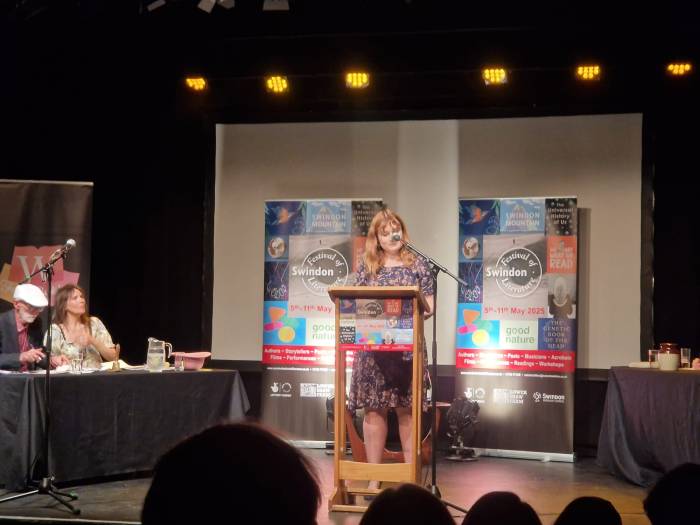
Performing at Swindon Festival of Literature

Ticking something off the Swindon bucket list, I can now say I’ve experienced the delight of reading/performing my fiction to a live audience at the Swindon Festival of Literature.

A piece of self-penned fiction, my story had the added “challenge” of needing to be performed in three minutes and in a way that kept the audience begging for more. I loved every second of it.

No performer is worth half of their talent without their trusty roadies. Ben did a brilliant job at suggesting revisions to my piece during the drafting stage, watching my performance in living room rehearsals and, most importantly, pumping me full of sugar and positivity on the night itself. (He’s also a dab hand at a camera.)

Thank you to the organisers of this event for helping to promote fresh voices and giving authors the platform to engage with new audiences.

**

Could you spare a dollar to support me? Donate here!

Alice’s Funding Page

**

Poetry Review: “This Is Wisdom: By Understanding My Poetry” by Ronnell Beaty

Rating: 2 stars

Headline: “This is Wisdom”: a poetry collection driven by passion but executed in a way that feels somewhat lacking

Review:

This is Wisdom: By Understanding My Poetry, is a collection of poems penned by author Ronnell Beaty.

Spanning 244 pages, the poetry collection itself covers around 200 pages. Topics of Beaty’s writing includes the spiritual and physical, as the reader transverses the inner workings of the poet’s deepest thoughts.
Most of the poems in Beaty’s collection are constructed as one line stanzas, with key words or phrases formatted in a bold typeface for added emphasis. This often results in a tone of voice that is either very punchy, or symbolic of the monotony of mundane human thoughts, witnessed strongly in the poem “I Be The First To Listen – And The Last To Speak!”. In this poem, Beaty transports readers into the head space of someone stripped of their voice. The deployment of repetition in this poem strikes out acutely across the stanzas, including the lines, “I don’t, // Even speak. // I just: // Listen… // I just: // Listen…” Used in this way Beaty’s words showcase an individual reduced to boredom, or even submission itself.

While there are some respectable elements of this collection, Beaty’s overuse of the same poetic style is repetitive and dry. There is a lack of variety to demonstrate the artistic merit of the author and, by keeping the tone of voice monotonous, it does tend to inspire feelings of boredom within the readership Beaty strives to inspire.


In additional to this, and despite the book presenting itself as quick read, the number of poems in this monosyllabic style becomes hard to overlook. It is what prevents This is Wisdom from inspiring much beyond a stifled yawn. There is talent in Beaty, so potentially the collection would have benefitted from being split into two distinctive books, done so to include more variety of poetic deployments.

A poetry collection driven by passion, This Is Wisdom is executed in a way that sadly feels somewhat lacking.


AEB Reviews

Links:

Reedsy Discovery Review: AEB Reviews – “This Is Wisdom: By Understanding My Poetry” by Ronnell Beaty

Purchase Link: “This Is Wisdom: By Understanding My Poetry” by Ronnell Beaty (Amazon)

**

Could you spare a dollar to support me? Donate here!

Alice’s Funding Page